EV Battery Degradation Data: What Fleet Managers Get Wrong About Battery Life
Alzbeta Lietava
Electrification Expert
Battery replacement fear is still the top reason buyers hesitate on EVs. The degradation data says otherwise, and for fleet managers, that opens the door to maintenance savings well beyond the battery.
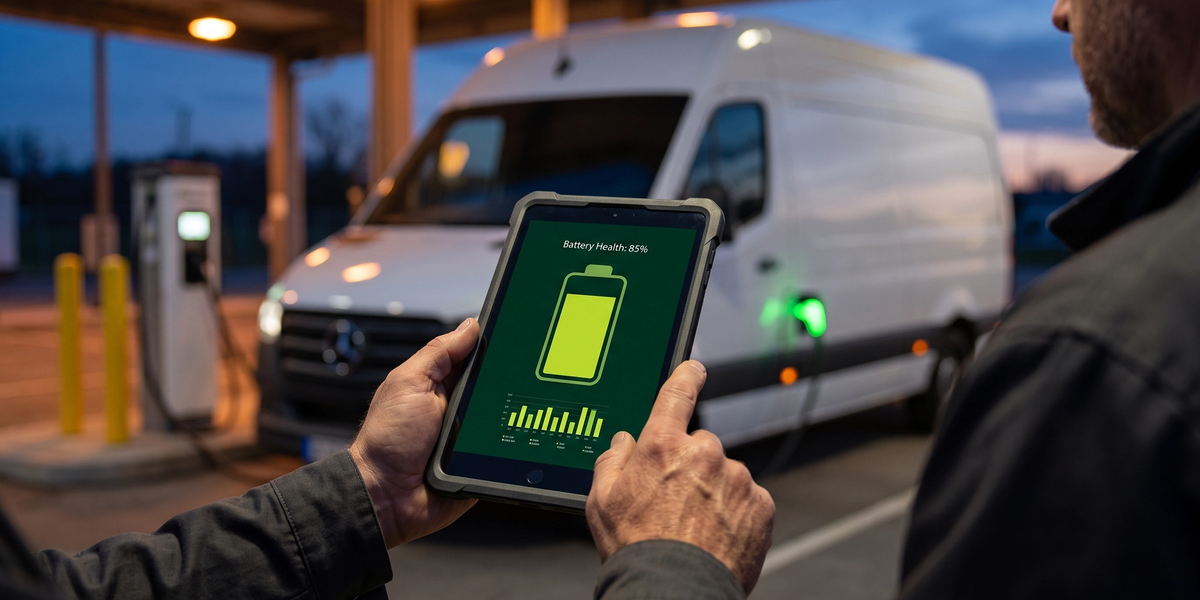
Ask a fleet manager why they haven't electrified yet, and the battery comes up fast. What happens when it degrades. What it costs to replace. Whether the math still holds in year six. It's a fair question, and it traces back to a real event, not just general nervousness about new technology.
Here's where that fear actually comes from. Most EVs today keep their battery at a safe, steady temperature by pumping liquid coolant around it, similar to how a car radiator cools an engine. The original Nissan Leaf, launched in 2011, skipped that system and cooled its battery with plain airflow instead. In hot places like Arizona, that meant the battery ran too hot for years, and heat is one of the fastest ways to wear a battery down. The result was real: some Arizona Leafs lost 30 to 40% of their capacity within just a few years, far more than owners expected. That one design shortcut on one 2011 model is a big part of why "the battery will die on you" became the default assumption about EVs, an assumption that has stuck around even though it has almost nothing in common with how batteries are built and cooled today.
What the EV battery degradation data actually shows
Geotab, a Canadian telematics company with one of the largest EV battery datasets in the world, tracks battery health across more than 22,700 vehicles and 21 models. Its most recent analysis puts average degradation for modern EV batteries at 2.3% per year, up slightly from the 1.8% recorded in its 2023 study as newer EVs with higher-power charging enter the dataset. At that rate, the average electric car battery retains 81.6% of its original capacity after eight years, in line with the industry's standard definition of expected longevity, since most manufacturers treat 80% original capacity as the end-of-life threshold for a pack. Most lithium-ion batteries in EVs today are rated for 1,000 to 1,500 full charge cycles, and some lithium iron phosphate (LFP) packs exceed 3,000, which in real-world terms works out to 150,000 to 300,000-plus kilometres before a battery meaningfully degrades. That's well beyond a typical vehicle's service life.
Range tells a similar story. Battery analytics firm Recurrent, drawing on a community of 30,000-plus electric cars, found the average EV retains 97% of its original driving range after three years and 95% after five. Replacement risk has followed the same curve down. Roughly one in 12 EVs built between 2011 and 2016, the same generation as that early Leaf, needed a battery replacement. For EVs built from 2022 onward, that figure sits at 0.3%, excluding the Chevrolet Bolt and Hyundai Kona recalls, which were manufacturing defects, not normal wear. Most EVs on the road today are only a few years old, so the long-term data set is still growing, but every update so far points the same direction.
Independent academic research backs this up. Researchers at the London School of Economics and the University of Birmingham analyzed close to 300 million UK vehicle test records and found battery electric vehicles now average an 18.4-year lifespan, on par with petrol vehicles and ahead of diesel vehicles, even when driven more kilometres.
What actually causes battery wear
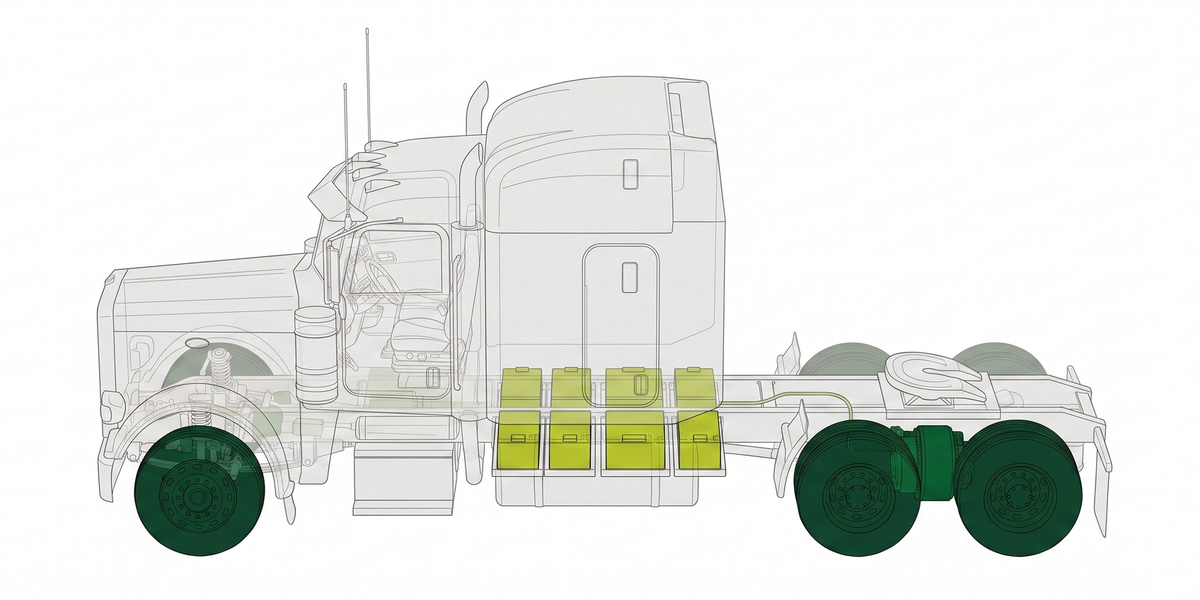
Electric semi truck battery pack and motor cutaway
Degradation isn't really about age or average age on the road. It's about how a battery gets charged, how often, and where it operates. Modern EVs run on high voltage battery systems, typically 400 volts, with newer performance models moving to 800-volt architecture for faster charging. Geotab's data shows EVs relying heavily on DC fast chargers above 100kW degrade at close to double the rate of vehicles charged mostly on Level 2 stations, 3.0% a year versus 1.5%. Extreme heat and extreme temperatures generally add roughly another 0.4% a year on top of that. Battery management systems limit some of this automatically, but frequent use of high-power fast charging stations still matters more than the calendar.
It's worth noting that the old rule of thumb, keep the charge between 20% and 80%, still holds for daily use, but the data shows it matters less than people assume. Degradation only accelerates meaningfully when a vehicle sits at a full charge or near-empty charge cycle for extended, habitual stretches, not from the occasional overnight top-up. For fleets running Level 2 depot charging and storing vehicles in moderate climates, none of this is a hard problem. It's a scheduling and telematics question, not a reason to stay on diesel vehicles.
The replacement fear, reframed
Most EV battery packs carry an 8-year or 100,000-mile warranty (roughly 160,000 km), guaranteeing at least 70% of original battery capacity through that period. Hyundai and Kia extend theirs to 10 years. California requires a minimum of 10 years or 150,000 miles for vehicles sold there, a benchmark other manufacturers are increasingly matching, though luxury brands tend to be less transparent about the specifics. As battery technology improves and thermal management gets more efficient, these warranty terms keep getting longer, not shorter, which tells you where manufacturers think the real risk sits.
A 2025 survey by AutoPacific, an automotive research firm that has studied consumer vehicle preferences since 1986, found that fear of an expensive battery replacement remains the single biggest reason prospective buyers walk away from an EV, according to reporting from the Wall Street Journal. That fear is targeting a failure that has nearly disappeared from modern EV batteries. Better chemistry, tighter thermal management, and smarter battery management systems have moved this from a real risk to a legacy concern left over from ICE cars and one badly cooled battery from 2011.
If the battery isn't the blocker, look at what else changes
Once the degradation data takes battery replacement off the table as a real risk, the rest of the EV ownership costs case gets a lot easier to see, starting with maintenance.
A battery electric vehicle runs on a single electric motor with roughly 20 moving parts, next to 2,000 or more in an internal combustion engine. There's no transmission fluid to change, no spark plugs, no fuel system or exhaust to service, and no oil changes on any schedule. Regenerative braking cuts wear on brake pads substantially, often stretching brake life well past what an ICE car sees. None of this makes an EV maintenance free. Fleets still budget for tires, which wear faster under EV torque and weight, along with brake fluid, cabin filters, and windshield washer fluid and wiper blades on the same schedule as any gas or diesel vehicle. But the categories that disappear are the expensive, frequent ones, and fewer moving parts overall means fewer things that can fail.
The independent numbers converge. A Canadian study by the 2 Degrees Institute found BEVs save an average of 71% in combined fuel and maintenance costs compared to ICE cars over a 250,000 km service life. Consumer Reports, looking at maintenance and repair alone, found EV owners pay about half as much as owners of comparable gas vehicles. For a fleet manager, that's not a rounding error. Upfront cost is still usually higher for an EV, but ownership costs, fuel plus maintenance combined, tip the other way well before the vehicle is replaced, often within the first year or two of operation.
There's a policy tailwind here too, worth checking before you buy rather than assuming. Canada's federal Electric Vehicle Affordability Program currently offers up to $5,000 toward eligible battery-electric vehicles, and businesses can claim an enhanced 55% first-year capital cost allowance on qualifying zero-emission vehicles through 2027. Quebec's Roulez Vert program still offers up to $2,000 through the end of 2026, though it's scheduled to wind down after that. Programs shift often, so confirm what's live before building it into a purchase decision.
None of this erases the fact that modern EVs still produce zero tailpipe emissions, a real factor if your fleet carries sustainability targets or emissions reporting. But the financial case doesn't need the environmental one to hold up on its own anymore.
The bottom line for fleet managers
The battery was a legitimate concern in 2011. In 2026, the degradation data, the warranty terms, and the replacement rates all point the same direction: it's the wrong thing to lose sleep over. If battery fear is what's been holding your fleet back from going electric, it's worth revisiting the decision with real-world numbers, because the maintenance savings and lower running costs are waiting on the other side of that assumption.
→ Use our free TCO Calculator to compare EV vs. ICE fleet costs for your operation.
For the full technical rundown on battery chemistry, range, and end-of-life recycling, see Everything You Need to Know About Electric Vehicle Batteries. For the complete maintenance cost breakdown, including per-kilometre numbers and Canadian rebate details, see EV vs ICE Maintenance Costs for Canadian Fleets.
Ready to Electrify Your Fleet?
Get expert guidance on transitioning to electric vehicles. Our team is ready to help.
Get a Quote