Everything You Need to Know About Electric Vehicle Batteries
Not all EV batteries are equal, and for fleet managers, the differences in battery chemistry, lifespan, and cost have real operational consequences. This guide covers everything Canadian commercial fleet operators need to know about electric vehicle batteries, from lithium ion battery types and driving range to degradation, total cost of ownership, supply chain developments, recycling processes, and emissions impact.
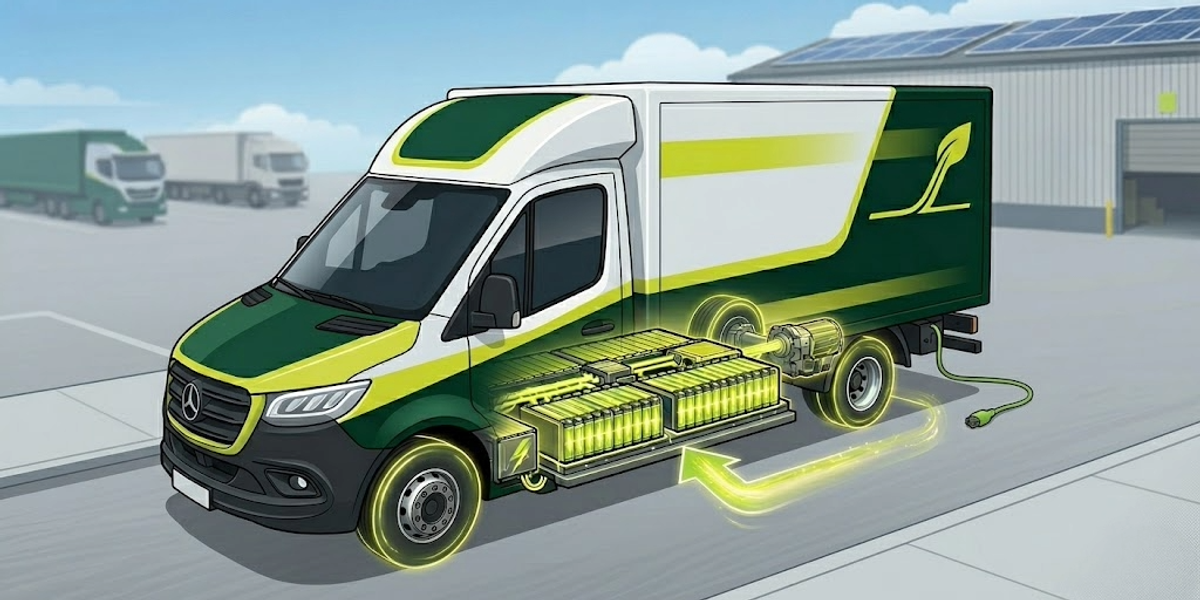
Electric van battery illustration
A comprehensive guide to EV battery technology for fleet managers, covering battery types, range, lifespan, supply chain, recycling, and emissions impact.
As fleets across Canada increasingly adopt electric vehicles, understanding EV battery technology is essential for long-term operational success. The decisions you make about battery chemistry, charging practices, and end of life planning directly affect your total cost of ownership and vehicle reliability.
This guide answers the most common electric vehicle battery questions for fleet managers, backed by the latest available data, and covers how EV battery advancements connect to charging infrastructure and sustainability goals.
What Types of EV Batteries Are Used in Commercial Vehicles?
Battery chemistry determines EV range, purchase price, battery lifespan, and safety. Here is what powers commercial electric vehicles today.
Lithium-Ion Batteries
Lithium ion batteries dominate the market. They are a mature technology used across both passenger cars and commercial fleets, and the primary choice for battery manufacturers supplying heavy duty vehicles. During operation, lithium ions move from the anode to the cathode through the electrolyte, creating the electrical current that powers the motor. Variants include:
- Lithium iron phosphate (LFP) battery cells, preferred for long battery life span, safety, and stable performance in cold climates. LFP has lower energy density but superior battery longevity, lower material costs, and can be charged to 100% without significant degradation, making it well suited for depot charging operations. LFP recently reached approximately 41% global market share by capacity for battery electric vehicles.
- Nickel cobalt manganese (NCM) and nickel cobalt aluminum (NCA) battery cells, used where higher energy density and driving range are priorities. NCA offers the highest energy density available but requires complex thermal management systems. NCM is common in mid-range commercial EV models.
Leading battery manufacturers including Tesla, Ford, and Stellantis are expanding LFP use for cost-efficiency, while NCA and NCM serve higher performance demands, according to the IEA Global EV Outlook.
Other Battery Types and Emerging Technology
Nickel metal hydride batteries were once standard in hybrid electric vehicles but are now largely phased out in modern EVs due to poor energy density and high cost. Lead acid batteries remain in auxiliary 12V roles only. Ultracapacitors pair with lithium ion batteries to deliver high power bursts during acceleration or regenerative braking.
On the horizon, solid state batteries are projected to have roughly double the energy density of current lithium ion batteries with ultra-fast charging capability under 15 minutes, based on current laboratory testing projections. Sodium-ion batteries, which avoid critical minerals entirely and perform well in sub-zero temperatures, are expected to enter wider commercial production for budget and city-focused EV models in the near future.
How Far Can Electric Vehicle Batteries Take You?
For most commercial use cases, driving range is no longer a barrier. Most electric trucks offer 300 to 500 km of real-world vehicle range, with long-haul models from Volvo, PACCAR, and Freightliner exceeding 600 km per charge. In the NACFE Run on Less Electric DEPOT study, more than 70% of vehicles completed daily routes with 40 to 60% of battery capacity still remaining.
Vehicle range varies depending on exact chemistry, battery capacity, load, temperature, and driving conditions. Fleet managers evaluating EV models should request real-world range data for their specific duty cycles rather than relying solely on laboratory testing figures.
Range performance is boosted by smart routing and telematics, regenerative braking recovering 10 to 15% of energy per charge cycle, improved thermal management for both hot climates and cold Canadian winters, and overnight depot charging to ensure electric vehicles start each shift at full original battery capacity. For best practices on range optimization, see EV Fleet Management Best Practices.
How Long Do EV Batteries Last?
Battery longevity is central to total cost of ownership, and the current outlook for fleet operators is strong. Most EV battery packs carry ev battery warranties of 8 years or 160,000 km, typically guaranteeing a minimum remaining capacity of 70% of original battery capacity. With proper battery management, electric car batteries can last 15 to 20 years depending on climate, driving habits, and charging practices, making battery replacement a rare event within a normal vehicle working life.
Understanding EV Battery Degradation
Battery degradation is the gradual reduction in a battery's ability to hold its initial capacity and store energy over time. Research shows EV batteries degrade at roughly 1.8% of maximum capacity per year on average, and new data confirms that extreme heat and frequent fast charging promote battery degradation more than age or regular use alone.
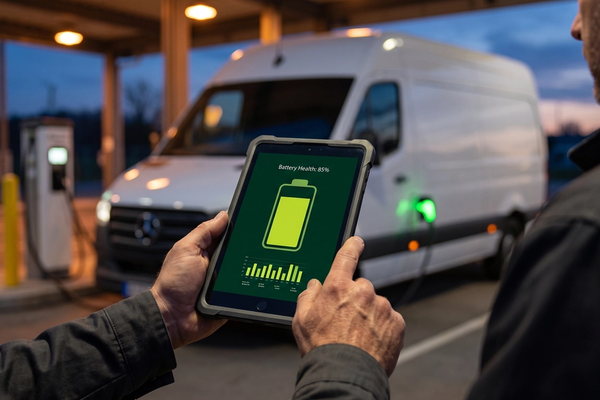
Battery management systems monitor individual cells, regulate thermal conditions, and prevent the conditions that cause premature battery health deterioration. The Battery Management System (BMS) tracks every cell's voltage, temperature, and state of charge to prevent overcharging or overheating. A battery pack with active battery management will consistently outperform one without it.
Best Practices to Extend Battery Life
Fleet managers and EV owners can significantly extend battery life by:
- Keeping the state of charge between 20% and 80% for daily operations
- Using AC charging as the primary method and reserving DC fast charging for when rapid charging is genuinely needed, as high charging power accelerates battery degradation
- Preconditioning battery packs before operation in extreme temperatures or hot climates
- Avoiding charging to 100% regularly, as this speeds up battery wear on individual cells
- Tracking average degradation across the fleet using battery management systems to identify vehicles needing attention before battery replacement becomes necessary
For a detailed maintenance comparison, see EV vs ICE Maintenance Costs.
What Does an EV Battery Cost and How Does It Affect Total Cost of Ownership?
Battery costs have fallen approximately 90% between 2010 and 2024 due to advances in battery chemistry and manufacturing processes. Despite this, batteries still represent 30 to 40% of an EV's total purchase price. Around 70% of battery cost is tied to materials used in individual cells, with cathodes alone accounting for 40 to 45% of that figure. This is why battery chemistry selection matters financially. Lower cobalt content in LFP reduces material costs while maintaining strong battery longevity.
As battery manufacturers scale manufacturing processes and North American gigafactory capacity grows, new battery costs continue to fall. Analysts project that new battery packs will reach cost parity with internal combustion engine vehicles within this decade.
Is Battery Supply Keeping Pace with Demand?
Yes. Canada is a leading producer of critical minerals needed for EV batteries, including nickel, cobalt, and lithium, which strengthens the domestic supply chain. Major gigafactories now operating or under development include Volkswagen PowerCo in St. Thomas, Stellantis/LG Energy Solution in Windsor, and new facilities in Bécancour. The IEA Global Battery Outlook projects over 20 gigafactories in North America in the coming years, reducing offshore dependency and lowering material costs through more efficient manufacturing processes.
What Happens to EV Batteries at End of Life?
Used EV battery packs play a key role in the circular battery economy.
Recycling Processes and Recovering Valuable Materials
Canadian companies including Lithion Technologies and Li-Cycle (acquired by Glencore Plc) use advanced recycling processes to recover valuable materials and critical minerals from used battery cells, recovering up to 95% of critical materials including nickel, lithium, cobalt, and graphite. Research published in Nature Communications on global EV battery material flows shows that advanced recycling processes could significantly reduce dependence on newly mined critical minerals. With high battery collection rates, recycled content from end of life EV battery packs has the potential to cover a meaningful share of future lithium and cobalt demand, reducing the need for new mining of critical minerals over time.
Second Life Applications
Electric car batteries that no longer meet the remaining capacity threshold for vehicle use can still reliably store energy in stationary applications. Second life EV battery systems support renewable energy projects and replace diesel generators in remote Canadian sites, extending the value of battery materials well beyond their first vehicle application.
Do Electric Vehicle Batteries Reduce Emissions?
Yes, and often faster than expected. According to the ICCT lifecycle analysis of heavy duty vehicles, emissions from EV battery production are offset within the first months of operation for most duty cycles. Over their lifespan, electric vehicles emit 40 to 70% less CO2 than internal combustion engine vehicles running on diesel fuel, even accounting for the full grid mix. In British Columbia, Quebec, and Ontario, where grids are among the cleanest in North America, the advantage over internal combustion engine vehicles is even more pronounced. Combined with recycling processes and second life battery use, EV battery technology makes fleet electrification one of the most effective tools for reducing greenhouse gas emissions across Canadian commercial operations.
What This Means for Fleet Decision-Makers
Advances in EV battery technology, battery production capacity, and recycling processes make the transition to electric fleets more practical and cost-effective than at any previous point. Battery life span has improved, battery replacement is rarely needed within a vehicle's working life, supply chains are strengthening, and the environmental case is backed by growing lifecycle evidence.
Fleet managers evaluating modern EVs should assess battery chemistry against their specific duty cycle, understand the expected longevity and degradation profile of the EV battery packs under consideration, and factor in the full end of life picture including recycling processes and second life value.
7Gen helps Canadian commercial fleets choose the right battery solutions, deploy EV charging infrastructure, and build a roadmap for electrification that aligns operational performance with sustainability goals. For transition planning guidance, see Planning and Executing an EV Fleet Transition.
→ Compare EV range, cargo, and payload with our EV Range Comparison tool.
→ Use our free TCO Calculator to compare EV vs. ICE fleet costs for your operation.
Ready to Electrify Your Fleet?
Get expert guidance on transitioning to electric vehicles. Our team is ready to help.
Get a Quote