EV vs Diesel Total Cost of Ownership for Canadian Fleets
EV vs diesel TCO breakdown for Canadian fleets: fuel costs, maintenance savings, carbon credits, incentives, and when EVs start paying off.

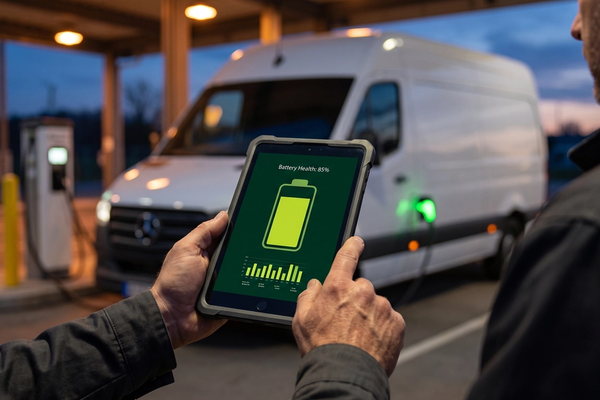
A fleet manager looks at the total cost of ownership for his vehicles
Total cost of ownership (TCO) for fleet vehicles measures every dollar spent over a vehicle's useful life, including acquisition, fuel or energy, maintenance, insurance, downtime, and disposal. For commercial fleets evaluating a switch to electric vehicles (EVs), TCO analysis consistently shows that battery-electric vehicles deliver 20–40% lower operating costs. This guide walks fleet managers through each cost category, explains where EVs win, and shows you how to run the numbers for your specific EV fleet.
See for yourself! Try the 7Gen TCO Calculator →
What Is Total Cost of Ownership and Why Does It Matter for Fleets?
Often, as a fleet manager, when it comes time to evaluate new vehicles, purchase price dominates the conversation. But even a new fleet manager knows that acquisition cost is only one input in a much larger equation. Fleet TCO captures the full economic picture by accounting for every cost the vehicle incurs from the day it enters your fleet to the day it leaves.
For internal combustion engine (ICE) vehicles, that includes fuel, oil changes, brake replacements, engine overhauls, DEF fluid, emission system repairs, and declining residual value. For electric vehicles, the cost structure looks fundamentally different: electricity replaces diesel, regenerative braking extends brake life by 2–3x, and the drivetrain has roughly 90% fewer moving parts. Plus, carbon credits actually make money, becoming a real revenue source for the business. The result is a dramatically different cost curve that favours EVs over time, even when upfront costs are higher.
Breaking Down TCO: EV vs. ICE Category by Category
1. Vehicle Acquisition
Electric trucks and buses carry a higher purchase price than their diesel truck and bus equivalents. However, with the rising price of fuel, provincial incentive programs like Quebec's Écocamionnage Program, and the capital cost allowance first-year deductions in Canada very quickly start to flip the numbers. Charging infrastructure costs are part of the upfront picture too, and are covered below. 7Gen's EV-as-a-Service leasing model further reduces the barrier by converting capital expenditures into a predictable monthly operating expense.
Interested in real numbers? Request a quote.
2. Fuel vs. Electricity Costs
This is where fleet electrification delivers its most dramatic advantage. In Canada, on a straight fuel-cost-per-kilometre basis, electricity runs about one-third the cost of diesel. For a fleet vehicle doing 40,000 km/year, that's roughly $14,400 in diesel vs. $5,200 in electricity costs, about $9,200/year in fuel savings per truck. These prices are based on nationwide averages, and the fuel spend savings could be more significant depending on where your EV fleet is charging. Even in jurisdictions with higher electricity rates, the per-kilometer energy cost for EVs runs 60–80% below diesel. Over the 10 year+ lifespan of a high-km vehicle, fuel savings alone can exceed the purchase price premium. Carbon credits push this advantage even further.
3. Maintenance and Repairs
Electric drivetrains are mechanically simpler. No oil changes. No transmission rebuilds. No exhaust aftertreatment systems. No DEF fluid. Regenerative braking reduces brake wear by 50–70%. Labor costs also drop significantly: fewer service appointments mean less technician time per vehicle and fewer unplanned repair events that pull drivers off route. Industry data suggests EV maintenance costs are roughly 30–50% lower than comparable ICE vehicles, with Consumer Reports finding about 50% maintenance savings over a vehicle's lifetime and the Canadian Energy Regulator citing maintenance costs about 70% below comparable ICE vehicles. For a fleet of 50 vehicles, that translates to hundreds of thousands of dollars in avoided maintenance over the fleet's lifecycle. The flip side: battery health monitoring is critical, and replacement costs (though declining rapidly) remain significant if a pack fails outside warranty.
4. Incentives and Carbon Credits
Federal incentives and provincial programs reduce the upfront cost gap, but carbon credits create ongoing revenue. In several Canadian provinces and U.S. states, EV fleet operators earn tradeable credits for every zero-emission kilometre driven. In Canada, those credits just exceeded $400 for the first time. 7Gen's platform tracks, reports, and brokers the sale of these credits for you, significantly reducing administrative work and turning an environmental benefit into a tangible revenue stream that directly improves your fleet TCO.
Try the 7Gen Carbon Credit Calculator →
5. Residual Value and End-of-Life
The EV resale market is maturing rapidly, with the gap between EV and diesel three-year depreciation narrowing significantly. Average EV depreciation now sits at roughly 38–42% after three years compared to 35–40% for conventional vehicles, a spread that continues to close as the market finds its footing. Federally mandated battery coverage of eight years or 100,000 miles gives buyers real confidence, and vehicles demonstrating 90–95% battery health are already commanding premium resale value pricing as transparent state-of-health reporting enables more accurate valuations. For fleet operators, residual value matters directly: working with financing partners who understand EV-specific depreciation trends can result in more competitive pricing, reducing exposure to depreciation risk and meaningfully lowering monthly lease costs across the fleet, making the total cost of ownership case for fleet electrification stronger with each passing year.
How to Calculate Your Fleet TCO
Running a credible fleet TCO analysis requires fleet-specific inputs. Here's the framework:
- Define your analysis period (typically 5–10 years for commercial vehicles).
- Gather your current diesel fleet costs: fuel consumption per route, maintenance records, insurance premiums, and downtime logs.
- Identify equivalent EV models for your vehicle class and duty cycle.
- Input your local electricity rates (on-peak and off-peak) and projected diesel prices.
- Stack available incentives: federal, provincial/state, municipal, and utility programs.
- Estimate carbon credit revenue based on your jurisdiction and projected annual mileage.
- Compare the two scenarios side by side. The point where cumulative savings in fuel and maintenance costs offset the purchase price premium is your payback period.
If this sounds like a lot of spreadsheet work, it is. That's exactly why 7Gen built a free TCO Calculator that automates the entire process. Input your fleet profile, fleet size, and duty cycle, and it generates a detailed cost comparison in minutes.
Common Mistakes in Fleet TCO Analysis
The most frequent error is comparing purchase prices and stopping there. Other common pitfalls include ignoring carbon credit revenue, using national average electricity rates instead of your actual utility tariff, failing to account for reduced downtime (EV fleets have higher uptime rates), and omitting charging infrastructure costs entirely. Depot charging installation typically runs $5,000–$15,000 per port for Level 2 charging, with sites requiring utility upgrades reaching $50,000 or more. Fleets that partner with an EV-as-a-Service provider convert these installation costs into a predictable monthly expense, shortening the payback period and improving the fleet TCO picture considerably. A rigorous model accounts for all of these. An incomplete one will mislead your leadership team in either direction.
The Bottom Line
When comparing the EV vs diesel total cost of ownership for most medium- and heavy-duty fleet applications with return-to-base routes, EVs already deliver lower lifetime costs than diesel over the full vehicle lifecycle. The fuel and maintenance savings are particularly compelling for last-mile delivery, regional distribution, and urban transit, where daily mileage fits within battery range and depot charging is straightforward. Cumulative savings compound over time as electricity costs stay stable and diesel prices remain volatile. The question is no longer whether EVs are cheaper to operate. It is how much money you are leaving on the table by waiting.
Ready to Electrify Your Fleet?
Get expert guidance on transitioning to electric vehicles. Our team is ready to help.
Get a Quote