EV vs ICE Maintenance Costs for Canadian Fleets (2026)
EVs cut fleet maintenance costs by up to 40% versus diesel. See the per-km numbers on service, brakes and batteries, plus 2026 Canadian rebates.
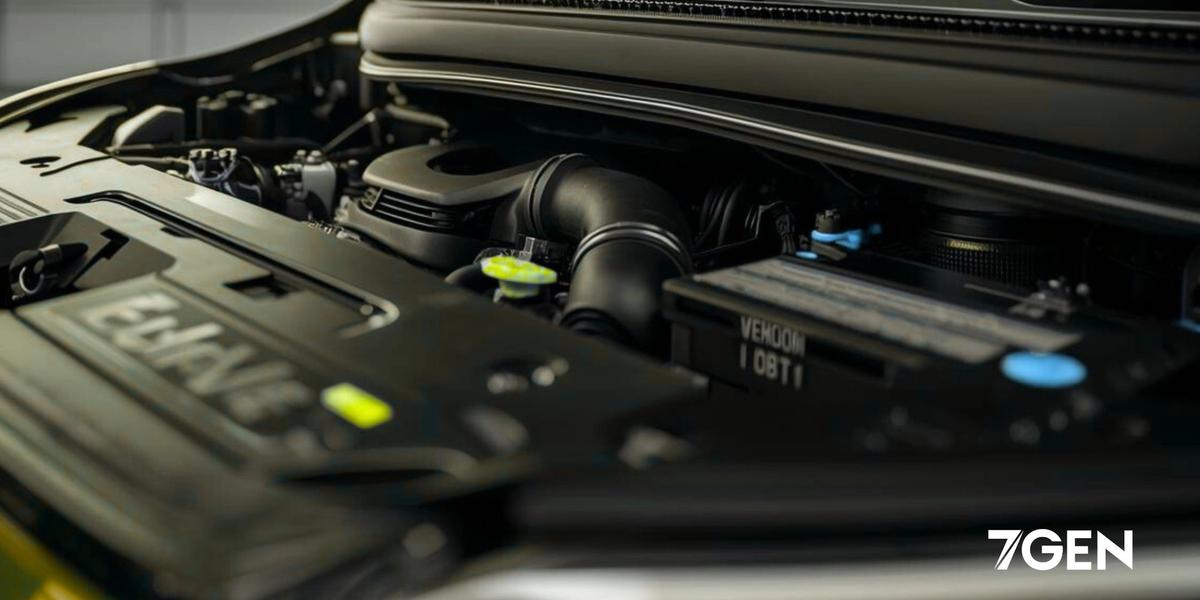
An EV engine has significantly less parts than its combustion engine counterpart.
With more shippers demanding zero-emission transport and government incentives making electric vehicles increasingly attractive, fleet managers are accelerating their shift toward electrification. As EV sales in commercial segments continue to grow, one question keeps coming up: how do EV maintenance costs really compare to ICE counterparts, and what does the difference mean for your annual budget?
The short answer is that electric vehicles require less maintenance than gas powered vehicles, and the savings are significant. While the upfront cost of electric trucks can be higher, the total cost of ownership often tilts in favour of EVs thanks to lower scheduled maintenance costs, fewer breakdowns, and lower fuel costs. This post breaks down where those savings come from, what EV drivers and fleet operators still need to budget for, and how Canadian incentives can reduce startup costs further.
EV vs Gas Vehicle Maintenance Costs: What the Data Shows
EVs consistently outperform gas and diesel vehicles when it comes to service, maintenance, and repair expenses across every commercial vehicle class studied. A 2 Degrees Institute study comparing fuel and maintenance costs of electric and gas powered vehicles in Canada found that, over a 250,000 km service life, BEVs save an average of 71% in combined fuel and maintenance costs compared to ICE vehicles. Fleet managers can expect lower costs almost immediately after switching, with calculated savings growing over five years of operation.
A Consumer Reports study found that EV owners pay about half as much for maintenance and repairs compared to comparable ICE vehicle owners. That holds for commercial fleets too.
According to the International Council on Clean Transportation (ICCT), battery electric trucks have the lowest per-kilometre maintenance costs of any powertrain (US data, directional benchmark for Canadian fleets):
- Battery-electric: ~$0.11/km
- Diesel: ~$0.15/km
- Natural gas: ~$0.19/km
EV maintenance costs are forecast to be 40% less than for an ICE fleet overall, with savings from reduced scheduled downtime and fewer unanticipated breakdowns. For fleet operators, the electric vehicle maintenance cost advantage is not marginal. It is structural.
Why Electric Vehicle Maintenance Costs Are Lower
What ICE Cars and Gas Engines Require
A traditional internal combustion engine relies on thousands of moving parts including spark plugs, a multi-speed transmission, fuel systems, and a full exhaust system with catalytic converters and mufflers. ICE cars, gas vehicles, and even hybrid vehicles require regular oil changes, fluid top-ups including windshield washer fluid and wiper fluid, exhaust system inspections, and eventual replacement of specialized drivetrain components. These are the common maintenance tasks that make gas powered vehicles more expensive to maintain over time.
Battery electric vehicles use a single electric motor with far fewer moving parts. There is no fuel system to service, no spark plugs to replace, no exhaust system to inspect, and no transmission fluid to change. This fundamental difference is the primary reason EVs and comparable ICE vehicles show such different ownership costs over their lifetimes.
Fewer Moving Parts Mean Lower Regular Maintenance
EVs can have as few as 20 moving parts compared to 2,000 or more in gas powered vehicles. Common maintenance tasks that dealers perform on gas cars simply do not apply to electric cars: no oil changes, no spark plugs, no transmission fluid or coolant flushes as routine service, and no serpentine belts or fuel injectors to replace. EV maintenance costs are about 70% lower than comparable ICE vehicles on a component basis. EVs tend to maintain this cost advantage across their full service life, not just in the early years.
Regenerative Braking Reduces Brake Wear
Regenerative braking systems recover energy during deceleration and reduce normal wear on brake pads and rotors. Electric Autonomy Canada reports that regenerative braking reduces brake wear by 50 to 70%, and EV brakes can last up to 200,000 km, more than triple the lifespan typical of gas powered vehicles. For high-mileage fleet vehicles, this is one of the most significant drivers of lower maintenance costs.
EV Battery Maintenance and Battery Longevity
While high-voltage EV batteries are the most expensive component, they require very little day-to-day maintenance. Modern EV batteries are typically designed to last throughout the vehicle's ownership period and are usually covered by warranties of 8 to 10 years. Real-world fleet data from Geotab, a Canadian company with one of the largest EV fleet datasets globally, shows EV batteries degrade at approximately 2.3% per year under typical fleet conditions, and many batteries last 15 or more years in service.
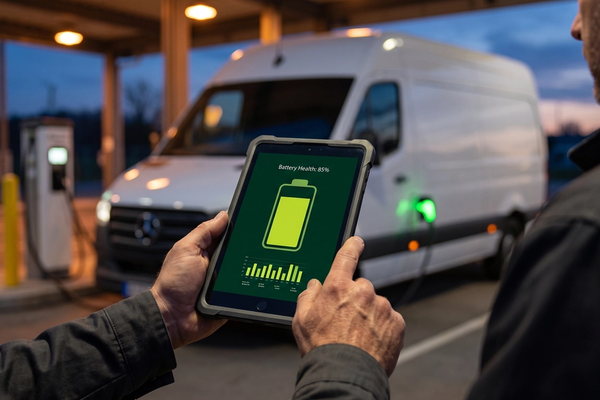
Telematics systems monitor battery health continuously, flagging changes in capacity before they affect uptime. In extreme temperatures, batteries lose capacity more quickly, making thermal management a key part of battery maintenance for Canadian fleets.
What Still Needs Maintenance on an EV
Despite lower overall maintenance burden, EVs are not maintenance-free. Fleet operators still need to budget for:
Tires and tire wear. EVs carry extra weight from their battery packs, and instant torque delivery accelerates tread wear on all four wheels, particularly front axles. Expect up to 20% more tire wear compared to ICE counterparts. A Ford Transit-based electric van is a practical example: load ratings and traction demand more frequent rotation intervals than the gas equivalent. Check air pressure regularly, as under-inflation compounds normal wear on heavier electric vehicles.
Brake fluid. While regenerative braking reduces wear on brake pads and rotors, you still need to replace brake fluid periodically. Brake fluid degrades with heat and moisture, and calipers and ABS modules require routine inspection as part of a scheduled maintenance program.
Thermal management and cooling systems. Modern EVs use liquid cooling loops to maintain optimal battery temperature. Inspect coolant levels and monitor pump performance using telematics. In Canadian winters, cooling system health directly affects battery life and electrical system reliability.
Cabin filters and wipers. Cabin air filters, air filters in HVAC systems, windshield wipers, and wiper fluid all require regular maintenance on the same schedule as gas cars.
Chassis and suspension. These components are subject to the same wear patterns as gas powered vehicles, particularly for fleets operating on rough terrain.
Total Cost of Ownership: The Full Picture for Canadian Fleets
EV maintenance is a major ownership costs driver, but not the only one. The levelized cost of driving (LCOD) for EVs is generally lower than for ICE vehicles, with a projected LCOD of $0.33/km compared to $0.34/km for ICE counterparts, a gap that widens as fuel prices fluctuate and electricity costs remain more stable.
Two areas where EVs run higher are worth noting. Insurance costs can be up to 12% higher than for ICE vehicles, reflecting higher repair costs for specialized EV components. Collision repair costs are also higher: average EV collision claims in Canada in 2024 reached approximately $7,241 CAD, compared to lower averages for many ICE models. These factors are real, but EVs are still meaningfully cheaper to operate overall. The money saved on scheduled service alone typically covers the insurance gap within the first year of operation.
Canadian Government Incentives for EV Fleet Adoption
Canadian government incentives can significantly reduce total lifecycle costs, particularly startup costs, making electrification more accessible for fleet operators at every scale.
At the federal level, the Electric Vehicle Affordability Program (EVAP), launched February 2026, offers up to $5,000 in rebates on eligible battery electric vehicles. Canadian businesses can also claim an enhanced first-year capital cost allowance (CCA) deduction of 55% on qualifying zero-emission commercial vehicles in 2026 and 2027. Note: the iMHZEV program for medium- and heavy-duty commercial vehicles closed March 31, 2026. A refreshed federal program is expected in late spring 2026; check Natural Resources Canada for confirmed details before applying.
At the provincial level, active programs include Quebec's Roulez Vert (up to $2,000 through December 31, 2026), Manitoba's rebate of $4,000 on new eligible EVs, and BC's CleanBC Go Electric program for fleet electrification and commercial vehicle purchases. In some provinces, funding is also available for suitability assessments and advisory services, helping operators determine the right vehicles and infrastructure before committing capital.
For a full breakdown of what is active and how to apply, see What You Need to Know About Canadian EV Fleet Incentives.
Sustainability: EVs and Carbon Emissions
Fleet electrification is not only a financial decision. Electric vehicles generate no tailpipe emissions or greenhouse gases (GHGs), making them a key component in helping companies meet sustainability targets. For fleet operators with strict emissions reporting requirements, an all-EV fleet eliminates the need to purchase carbon offsets, delivering direct cost savings beyond what maintenance comparisons capture. As Canada's electricity grid incorporates more renewable energy, the emissions advantage of EVs over ICE vehicles will widen further.
The overall carbon emissions of EVs are lower than those of ICE vehicles when considering the entire lifecycle, including manufacturing, energy grid emissions, and end-of-use recycling. Early electrification locks in both carbon and cost savings ahead of tightening regulations.
Tips for Reducing Fleet Maintenance Costs After Switching to EVs
Upskill your workforce. EVs require different diagnostics than gas powered vehicles. Natural Resources Canada (NRCan) offers a national EV technician training platform covering safety protocols and high-voltage component servicing.
Adapt your maintenance schedules. Shift focus from engine diagnostics to electrical system health, battery health checks, and thermal management. Use telematics to track energy efficiency, battery health, regenerative braking performance, and cooling system status in real time, reducing reactive repairs and helping drivers maintain consistent performance standards.
Work with a specialized electrification partner. Leasing with an EV-focused partner like 7Gen means 24/7 support and remote diagnostics, service, maintenance, and repair tracking embedded in every lease, and preventative maintenance included in select regions. For more on the financial case, see The TCO Reality: Why the Sticker Price of EV Fleets Is Deceiving and EV Fleet Management Best Practices.
EV vs Gas Fleet Maintenance Costs: Key Takeaways
- Electric vehicles require less maintenance than gas powered vehicles across every commercial vehicle class
- EV maintenance costs are about 70% lower than comparable ICE vehicles on a component basis, and approximately 40% lower in overall fleet operating costs
- Lower scheduled maintenance costs come from fewer moving parts, no oil changes, longer-lasting brake pads, and the elimination of common maintenance tasks that gas cars require
- EV maintenance costs are partially offset by higher tire wear (up to 20% more) and insurance costs (up to 12% higher)
- Modern EV batteries are designed for longevity, with warranties of 8 to 10 years and real-world lifespans that regularly exceed 15 years
- Canadian government incentives including EVAP and the 55% CCA deduction can meaningfully reduce startup costs
- EVs produce no tailpipe emissions or GHGs, helping fleets meet sustainability targets and avoid carbon offset purchases
For a deeper look at EV battery technology, see Everything You Need to Know About Electric Vehicle Batteries.
→ Use our free TCO Calculator to compare EV vs. ICE fleet costs for your operation.
Ready to Electrify Your Fleet?
Get expert guidance on transitioning to electric vehicles. Our team is ready to help.
Get a Quote