Go Electric Rebates Return August 10, 2026: What B.C. Fleets Need to Know
Alzbeta Lietava
Electrification Expert
British Columbia's Go Electric Rebates program reopens August 10, 2026 with point-of-sale rebates up to $130,000 per medium- and heavy-duty ZEV. Here are the new per-class amounts, who qualifies, how to claim retroactively if you bought during the 2025 pause, and how the rebate stacks with charging support and federal incentives.
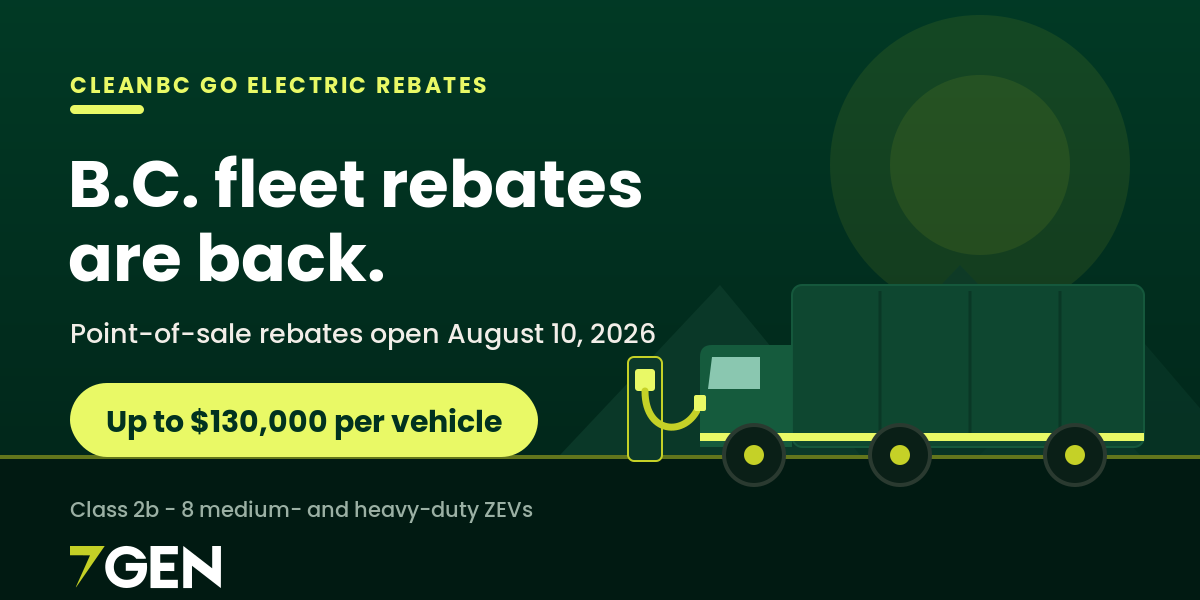
A commercial electric truck plugging into a charging station, announcing that B.C. fleet rebates up to $130,000 for Class 2b to 8 vehicles return on August 10, 2026.
British Columbia's biggest commercial EV incentive is back. On August 10, 2026, the CleanBC Go Electric Rebates program reopens with point-of-sale rebates of up to $130,000 per medium- and heavy-duty zero-emission vehicle. With the federal iMHZEV program now ended, this is the primary rebate built for commercial fleets running medium- and heavy-duty vehicles in B.C. For operators who paused plans during the August 2025 hold, the wait is over.
Here is what changed, how much you can claim, how it stacks with other EV incentives, and what to do now.
The program was refreshed, not just restarted
The Province paused the program in August 2025 to make changes that better match market needs. The refreshed version keeps the same goal, lowering the cost of commercial zero-emission vehicles (ZEVs) on B.C. roads, but now pays by vehicle class on a point-of-sale model: you get the rebate at the dealership when you pay, not as a later reimbursement.
The program is administered by CLEAResult Canada and funded by CleanBC through the B.C. Ministry of Energy and Climate Solutions. Rebates go to B.C.-based businesses, Indigenous organizations, local government organizations, and non-profit organizations buying eligible Class 2b through Class 8 ZEVs.
Rebate amounts by vehicle class
Incentive amounts scale with vehicle class. Indigenous organizations, local governments, and non-profits receive a 20% top-up, pushing the maximum rebate to $156,000 for a Class 8 vehicle.
| Vehicle class | Class 2b (no pickup trucks) | Class 3 (no pickup trucks) | Class 4-5 | Class 6-7 | Class 8 |
| Rebate amount | $5,000 | $30,000 | $60,000 | $90,000 | $130,000 |
| Rebate with 20% top-up | $6,000 | $36,000 | $72,000 | $108,000 | $156,000 |
Battery electric vehicles and hydrogen fuel cell electric vehicles qualify for the full amount. Plug-in hybrid vehicles are eligible at 50% of the rebate for their class.
Who qualifies and how many vehicles
The program is open to B.C.-based businesses, Indigenous organizations, local government organizations, and non-profit organizations. Any qualifying public entity or private operator must be a registered legal entity based in B.C. Annual vehicle limits:
- Businesses: up to 5 vehicles per year
- Indigenous organizations, local governments, and non-profits: up to 10 vehicles per year
Two conditions matter for planning. Rebated vehicles must operate in B.C. for at least 48 months, and leased vehicles qualify when the term is 48 months or longer (shorter leases get a prorated rebate). Passenger transportation vehicles such as shuttles, buses, and motor coaches may qualify, with a valid B.C. passenger transportation licence. School buses may be eligible only where no other provincial program covers that category.
Vehicle eligibility and the eligible vehicle list
Only new vehicles on the official eligible vehicle list earn a rebate, and the list grows as more models are approved. Eligible vehicles are new, commercially designed Class 2b-8 ZEVs registered in B.C. Pickup trucks are not eligible.
It already covers battery electric models from manufacturers such as BrightDrop, Ford, Isuzu, Freightliner, Kenworth, Peterbilt, Volvo, Lion, and BYD, spanning cargo vans, step vans, straight trucks, tractors, shuttles, refuse trucks, and school buses. Models on the list before the 2025 pause remain eligible. Confirm eligibility against the exact make, model, year, and configuration before you order. Under the federal programs governing broader EV eligibility, vehicles must also meet Canadian Motor Vehicle Safety Standards and be highway-capable.
How the point-of-sale rebate works
The process runs in five steps, built around pre-approval so funds are reserved before you commit:
- The buyer applies online to reserve funds for up to 2 months.
- The buyer chooses an eligible ZEV and orders through an approved seller.
- The approved seller applies to reserve funds for up to 12 months while the vehicle is built and delivered.
- The buyer receives the rebate as a discount when they pay for the vehicle.
- The seller applies for reimbursement within 45 days of the sale.
Funding dates: apply early
Funding is released on planned dates, and intake closes temporarily if funds run out before the next release. Additional funding is scheduled for:
- August 10, 2026: program opens
- December 10, 2026: funds added, intake reopens if closed
- April 12, 2027: funds added, intake reopens if closed
Rebates are first come, first served, so applying early in each window protects your spot.
Bought a ZEV during the 2025 pause? You may qualify retroactively
If you took delivery of a medium- or heavy-duty ZEV during the pause, you may still claim a rebate. You must meet all of these criteria:
- The vehicle is an MHD ZEV, Class 5 to 8.
- It was on the Go Electric Rebates eligible vehicle list as of August 11, 2025.
- It was ordered between February 11, 2025 and August 11, 2025.
- You received it after August 11, 2025.
Retroactive rebates count toward your 10-vehicle limit for the 2025 calendar year, funds are limited, and applications are first come, first served. Move quickly if you qualify.
Get ready before August 10
- Confirm your Business BCeID. Every applicant needs one to apply. If you do not have one, start registration now so it is active before August 10.
- Plan your charging or fuelling before you buy.
- Match a vehicle to your routes, confirming the model is on the eligible list and its electric range fits your duty cycle.
Pair the rebate with charging and fleet planning support
The vehicle rebate covers the truck. A separate set of provincial programs helps with EV charging, worth lining up at the same time.
The CleanBC Go Electric Fleet Charging Program covers up to 50% of charging station purchase and installation costs, rising to up to 75% for Indigenous organizations, plus up to 40 hours of free advisory support through Plug In BC. It supports depot charging and, where relevant, hydrogen refuelling stations.
For planning, the BC Hydro Fleet Electrification Program funds an EV Ready fleet plan, covering 50% of planning costs up to $15,000 to hire an expert for fleet suitability assessments and infrastructure and facility assessments. These identify your charging requirements, electrical infrastructure needs, and any service upgrades before you buy hardware. You apply for pre-approval by submitting a proposal, which also builds the business case for the transition.
The federal Zero-Emission Vehicle Infrastructure Program (ZEVIP) closed to new applications on March 20, 2026, so charging infrastructure funding now varies by province. In B.C., the programs above are the route to charging and electrical infrastructure support.
How Go Electric Rebates fit with other EV incentives
Government incentives come from both federal and provincial sources, and they target different vehicles. The federal Electric Vehicle Affordability Program (EVAP) launched February 16, 2026 and offers up to $5,000 for new battery electric and fuel cell electric vehicles and up to $2,500 for plug-in hybrid electric vehicles. The purchase or lease must be dated on or after launch, and the vehicle must be made in Canada or in a free-trade-agreement country. The after-tax vehicle price, the final transaction value, must be $50,000 or less, with no price cap on Canadian-made vehicles. EVAP targets light-duty EVs, so it generally does not apply to Class 2b-8 trucks. The federal iMHZEV program, which previously offered up to $200,000 for medium- and heavy-duty ZEVs, ended in 2026.
Federal rebates can typically be combined with provincial incentives. Quebec's Roulez vert offers up to $2,000 for a new EV (MSRP under $65,000) through end of 2026, and Manitoba offers $4,000 (MSRP under $70,000). Some programs also support cargo e-bikes. These passenger-focused rebates rarely fit a commercial fleet, which is why Go Electric Rebates matters: it is the incentive designed for medium- and heavy-duty operators.
Why fleets are making the switch
The rebate lowers the sticker price, but the real case is on the road. Electric drivetrains have far fewer moving parts than diesel. Battery electric vehicles cut fuel costs by roughly 60% versus a comparable gas or diesel vehicle, and maintenance runs about 30% lower with no oil changes and fewer failures. Electric trucks stay in service longer, with lifespans often cited around 15 years, and over a typical 5-year horizon the total cost of ownership usually lands below diesel. Carbon credit revenue, which 7Gen administers, improves the economics further.
How 7Gen helps you capture the full rebate
7Gen handles vehicles, charging infrastructure, fleet software, and carbon credit administration under one contract, so you are not coordinating a dealer, an electrician, a software vendor, and a carbon consultant on your own. We help you select eligible models, time orders to the funding windows, and pair the rebate with charging and fleet-planning support.
→ Use our free TCO Calculator to compare EV vs. ICE fleet costs for your operation.
Ready to plan around the August 10 reopening? Get a Quote and we will map the rebates, charging, and timeline for your fleet.
Ready to Electrify Your Fleet?
Get expert guidance on transitioning to electric vehicles. Our team is ready to help.
Get a Quote