Commercial EV Fleet Trends Canada 2026: The Report
Alzbeta Lietava
Electrification Expert
The commercial EV fleet trends shaping Canada in 2026: the electric trucks, cargo vans, ranges, charging, total cost, and incentives that matter for Canadian fleet operators this year.
The headlines vs. the fleet yard
The electric vehicle headlines turned positive in 2026. After a record 2024 and a rough patch in early 2025 when rebates paused, sales came back strongly: Canadian ZEV sales rose about 21% in the first four months of 2026, with March alone up nearly 75% year over year, helped by high gas prices and the new federal Electric Vehicle Affordability Program. The consumer auto market is clearly rebounding.
For commercial fleets, the story is quieter but more durable. Fleet operators do not buy on momentum or headlines. They treat electric as a practical business asset, buy it on the business case, and take control of fuel and maintenance costs. The electric trucks and cargo vans built for commercial work now go farther, charge faster, and cost less to run than the models offered two years ago.
This report lays out the commercial EV fleet trends shaping Canada in 2026: the models, the ranges, the charging, the total cost, and the incentives that decide whether a route pencils out.
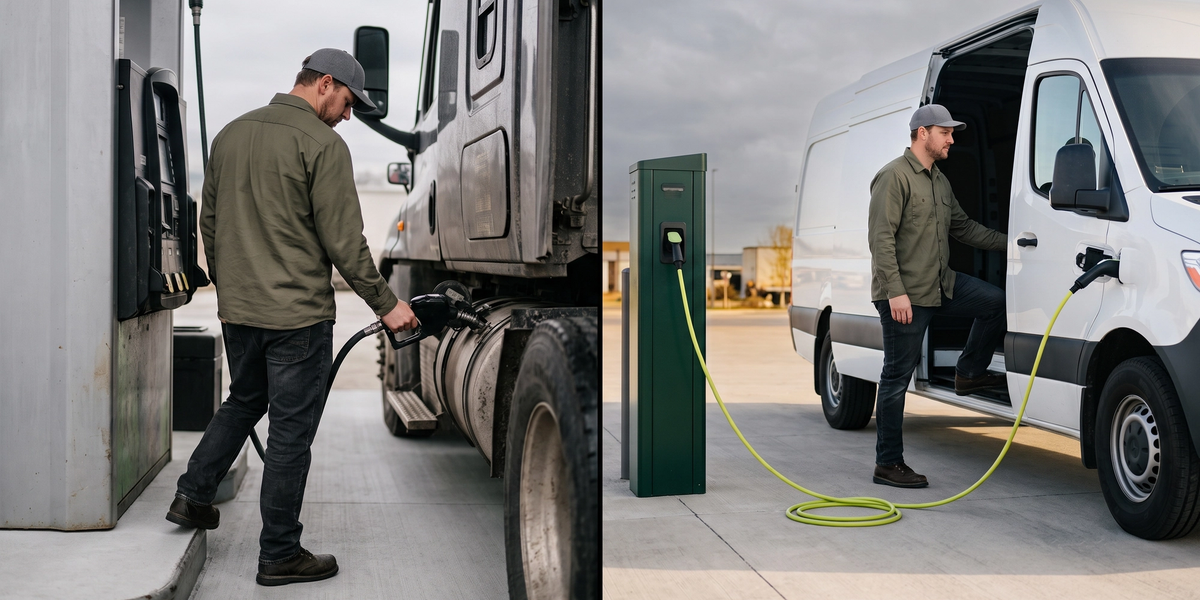
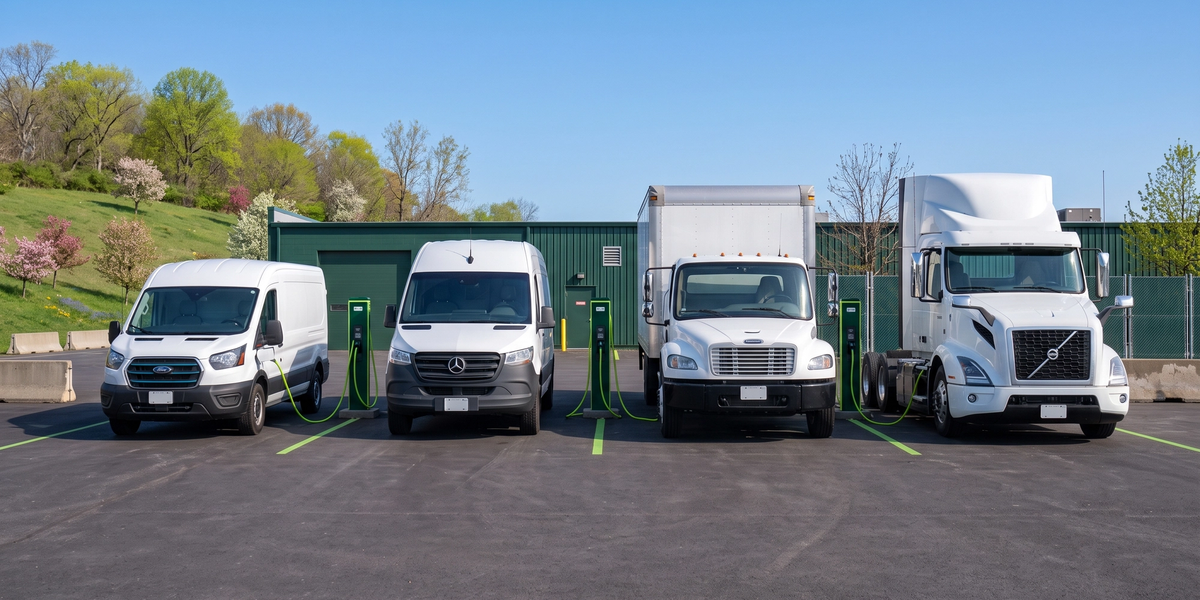
EV van charging vs. diesel truck fuelling.
Key takeaways
Here are the commercial EV fleet trends defining Canada in 2026, in brief:
- Battery electric and plug-in vehicles reached 10.3% of new light-duty vehicle sales in Canada in 2025, recovering to 12.1% by Q4. Medium- and heavy-duty ZEVs hit 2.1% in the second half.
- The cargo van class matured, with four credible electric options covering roughly 255 to 480 km.
- Electric trucks from Volvo and Freightliner cover 300 to 440 km with fast DC charging, enough for most regional and last-mile routes.
- A battery electric vehicle costs about 3 to 4 cents per kilometre in electricity versus 12 to 14 cents for gasoline, roughly a quarter of the fuel cost.
- Federal purchase support for heavy-duty vehicles ended in early 2026, but the enhanced capital cost allowance, provincial programs, and carbon credit revenue keep the business case strong.
The 2026 commercial EV fleet market in Canada
The market rode a roller coaster. ZEV sales hit new highs in 2024, dropped sharply in early 2025 as rebates paused, then recovered to close the year strong. The Canada Energy Regulator reports more than 170,000 ZEVs sold in 2025, with the monthly share reaching 12.5% by December.
Transport Canada's EV dashboard tells the fleet story. Light duty vehicles ended 2025 at a 10.3% ZEV share, while medium and heavy duty vehicles held at 2.1%. More than 10,000 medium- and heavy-duty battery electric vehicles now operate on Canadian roads, concentrated in Quebec and British Columbia. Urban and last-mile delivery fleets lead adoption, and the sector is shifting from pilots to economic scaling. Ottawa launched the Electric Vehicle Affordability Program in February and repealed the Electric Vehicle Availability Standard, so fleets now rely more on the business case, which is where electric performs best.
Cargo and delivery vans: the class that grew up
The electric cargo van is where fleet electrification gets practical: predictable mileage, return-to-base routes, and overnight depot charging.
| Model | Class | Battery | Estimated range | DC fast charge |
|---|---|---|---|---|
| Ford E-Transit | 2 | 89 kWh | ~255 km | 10 to 80% in ~28 min |
| Mercedes-Benz eSprinter | 2/3 | up to 113 kWh | up to ~400 km (mfr est.) | ~10 to 80% in ~30 min |
| Ram ProMaster EV | 2 | 110 kWh | ~265 to 290 km | ~150 kW peak |
| BrightDrop Zevo (GM) | 2/3 | large-format | ~290 to 480 km | ~150 kW+ |
The Ford E-Transit is the volume workhorse with the widest service network in Canada. The Mercedes-Benz eSprinter offers the longest range, the BrightDrop Zevo the most cargo volume, and the Ram ProMaster EV a low load floor. Electric powertrains bring instant power, regenerative braking that extends brake life, and cabs equipped with the advanced tech drivers expect, including Apple CarPlay and modern safety systems, which eases driver adoption for fleets going electric for the first time. Across the model line, weigh the manufacturer's suggested retail price against the operating savings, and treat these ranges as manufacturer estimates rather than the actual range you will see in winter.
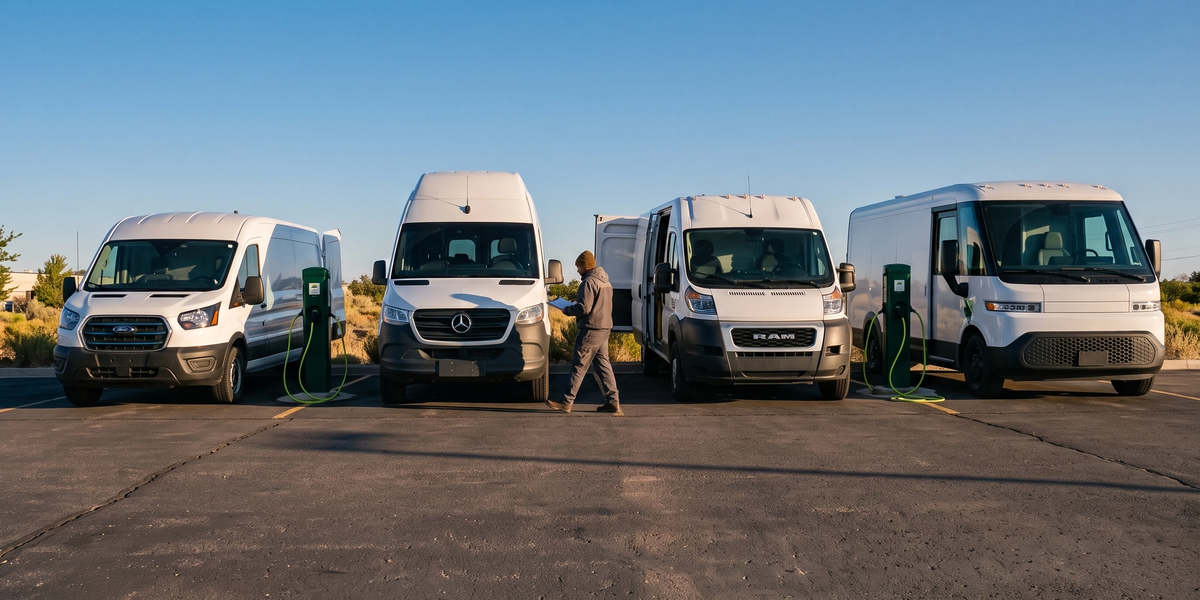
Four electric cargo vans charging at a depot.
→ Compare real-world EV range for your routes with our free EV Range tool.
Medium and heavy trucks: regional and last-mile ready
Heavier classes moved from pilots to production orders, carrying heavier payloads and delivering on local distribution, food and beverage, and regional haul routes with frequent stops.
| Model | Class | Battery | Operating range | Charging |
|---|---|---|---|---|
| Freightliner eM2 | 6/7 | 194 to 291 kWh | ~305 to 400 km | up to 270 kW DC |
| Freightliner eCascadia | 8 | up to 438 kWh | ~355 to 370 km | up to 270 kW DC |
| Volvo VNR Electric | 8 | 375 to 565 kWh | up to ~440 km | up to 250 kW, 80% in 60 to 90 min |
| RIZON (Daimler) | 4/5 | modular | urban duty cycles | DC fast charge |
The Volvo VNR Electric reaches up to 440 km and recharges to 80% in about 90 minutes. Freightliner's eM2 and eCascadia cover the medium- and heavy-duty middle, and Daimler's RIZON handles tight urban work in Class 4 and 5. Global benchmarks like the Mercedes Benz eActros 600 (621 kWh, roughly 500 km), BYD's 435 kWh Class 8 tractor, and the Tesla Semi (45,000 lb loads, under 2 kWh per mile) show battery capacity and efficiency still climbing fast, with newer batteries adding range even where the models are not yet sold in Canada.
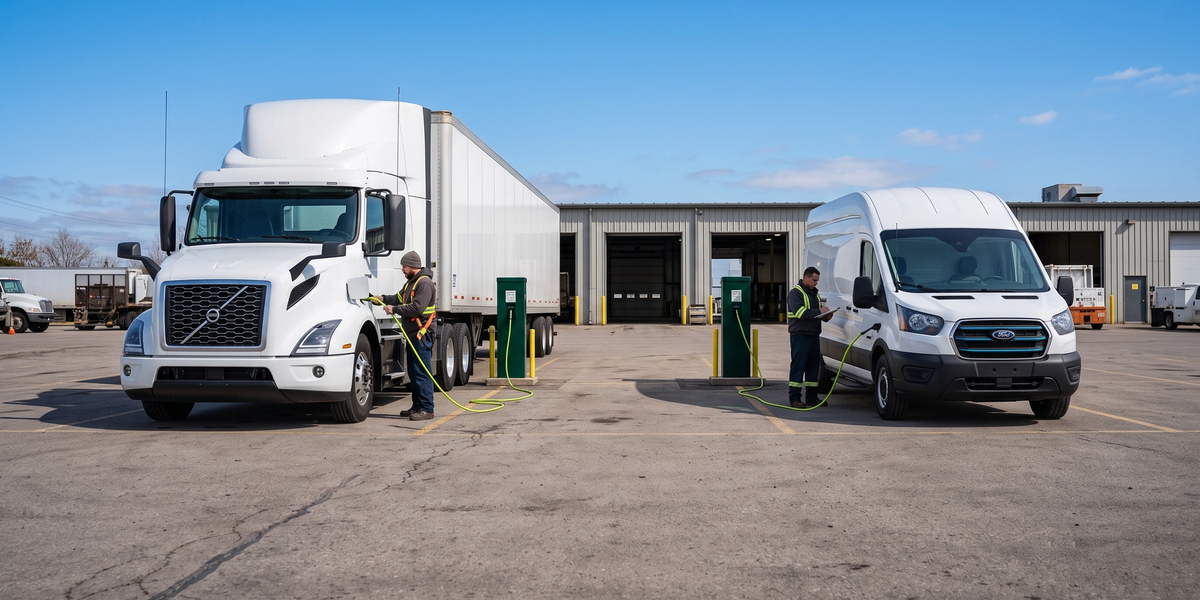
Electric semi-truck and cargo van charging at a depot.
Range in the real world: the winter question
Winter range is the plan, not a footnote. The Canadian Automobile Association drove 14 popular EVs from Ottawa to Mont-Tremblant at -7°C to -15°C and found winter driving cut rated range by 14% to 39%, with broader testing averaging about 30%. Precondition the cabin and battery while plugged in, favour vehicles with heat pumps, which hold 5% to 10% more range in the cold, and size vehicles to the route with a winter buffer rather than the summer spec. For the full playbook, see 7Gen's guide to maximizing EV range, battery life, and uptime.
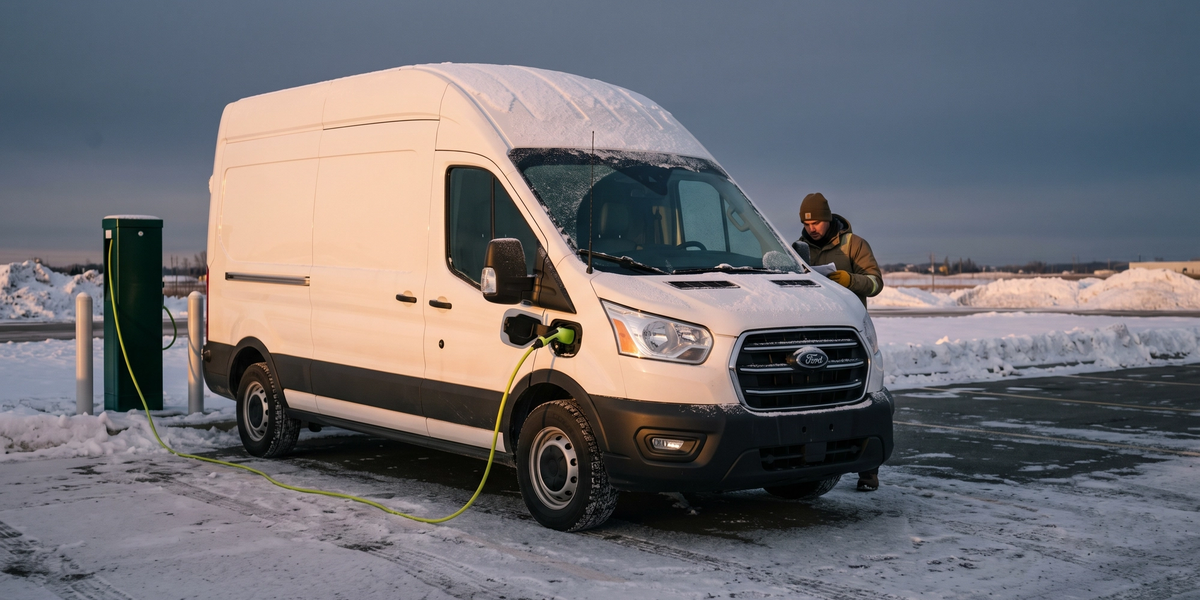
Electric cargo van charging in winter.
Charging and infrastructure
Public charging keeps growing. Canada ended 2025 with more than 38,000 public charging stations, over 8,000 of them Level 3, plus a small network of hydrogen refuelling stations. For a fleet, the depot charger matters most: overnight Level 2, topped up with DC fast charging when a route demands it, is the most efficient setup for daily duty cycles. Charging economics vary by province, so it pays to know your EV charging rates across Canada and to model real charge times with 7Gen's EV charging curve simulator, which accounts for vehicle, charger, and temperature. Charging infrastructure is the biggest challenge to fleet expansion and now a strategic investment. The federal Zero Emission Vehicle Infrastructure Program (ZEVIP) funds charging stations and hydrogen refuelling stations through 2027, though this emission vehicle infrastructure program's main streams are closed and funding is limited. In British Columbia, the CleanBC Go Electric Fleet Charging Program, an electric fleet charging program, provides financial support covering up to 50% of purchase and installation costs, rising to 75% for Indigenous communities, and applicants must be pre approved before installing chargers, so early planning secures access. 7Gen handles designing, installing, and maintaining depot charging so it is ready when the vehicles arrive.
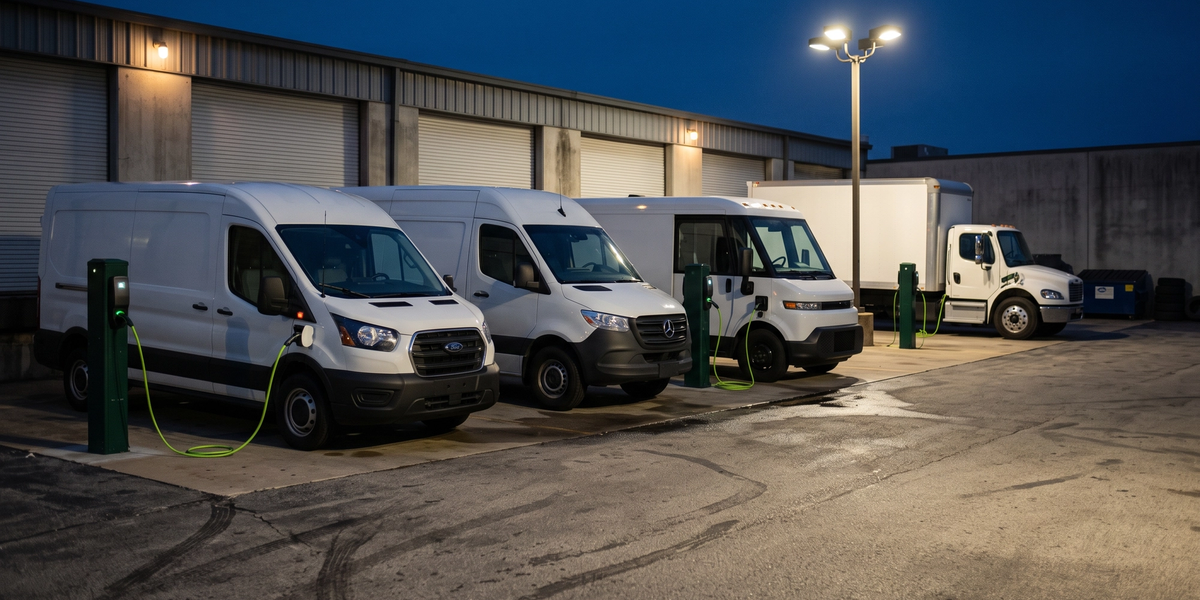
Electric fleet charging at a depot overnight.
The money: total cost of ownership
Sticker price is the wrong place to stop. Fleets focus on total cost of ownership. A battery electric vehicle costs about 3 to 4 cents per kilometre in electricity versus 12 to 14 cents for gasoline, roughly a quarter of the fuel cost, since EVs use energy far more efficiently than gas cars. Electricity runs about a third the cost of diesel: a vehicle covering 40,000 km a year faces roughly $14,400 in diesel versus about $5,200 in electricity, close to $9,200 saved per vehicle each year. Maintenance runs 30% to 50% lower thanks to fewer moving parts and regenerative braking. The bottom line: for many small and medium businesses, an electric fleet pays back its higher upfront cost within about two years.
→ Use our free TCO Calculator to compare EV vs. ICE fleet costs for your operation.
The incentive picture in 2026
Programs changed, so verify current status before you budget, and 7Gen tracks the current picture in its guide to Canadian EV fleet incentives. The federal Electric Vehicle Affordability Program launched February 16, 2026, for light-duty vehicles: up to $5,000 for battery electric and hydrogen fuel-cell vehicles and $2,500 for plug-in hybrids as point-of-sale financial assistance. Fleet use is capped at 10 incentives per organization, with businesses, non profit organizations, Indigenous organizations, and government fleets eligible. The medium- and heavy-duty iMHZEV program, once up to $200,000 per vehicle, ended March 31, 2026, with no federal replacement, so larger fleets rely on the enhanced capital cost allowance, provincial programs, and carbon credits.
Provincial support remains real. Quebec's Roulez Vert offers up to $2,000 through 2026, and Manitoba's rebate, extended in Budget 2026, offers $4,000 new and $2,500 used under a $70,000 manufacturer's suggested retail price. Every zero-emission kilometre earns tradeable credits under the federal Clean Fuel Regulations, active nationwide, with BC's Low Carbon Fuel Standard stacking on top. Credits can be sold to offset operating costs and are not subject to funding limits like rebates, so they are an ongoing revenue stream rather than a one-time discount. See how the numbers work in 7Gen's breakdown of the economics of EV fleets with carbon credits.
→ See how much your fleet could earn with our Carbon Credit Revenue Estimator.
Software, telematics, and data
Telematics and fleet management software are now standard, giving real-time visibility into charging status, energy cost, battery health, and carbon performance in one place. Fleets increasingly use data analytics and AI to maximize vehicle utilization, matching the right vehicle to the right route and keeping expensive assets working. That visibility keeps operations running efficiently, and it is built into 7Gen's fleet management solutions.
What it means for your fleet
Strip away the noise and the commercial EV fleet trends in Canada point one way in 2026: the vehicles are ready. The momentum is real, but for fleets the case was never about headlines. Range is up, charging is faster, model choice is real, and the economics favour electric for the routes fleets actually run. The barriers that remain, higher upfront cost and uneven charging infrastructure, are exactly what a full-service company like 7Gen solves. Hundreds of Canadian customers already operate this way. Discover what your own numbers look like with the calculators on our website, or contact the 7Gen team to map your first electric routes.
Ready to Electrify Your Fleet?
Get expert guidance on transitioning to electric vehicles. Our team is ready to help.
Get a Quote