The Real Cost of EV Charging for Canadian Fleets (2026)
EV charging costs as little as $2.25 per 100 km vs $20 for diesel. Compare provincial rates, demand charges and depot install budgets.
EV Charging
For Canadian fleet managers evaluating the shift to electric vehicles, charging costs are the first financial question that needs a clear answer. The cost to charge an electric car in Canada depends on several factors: your province, the type of charger, when you charge, and how your depot is set up. This guide breaks down every component, from per-kilowatt hour energy rates to hardware and installation, so you know exactly what to budget for.
The cost to charge an electric car in Canada ranges from $0.07 to $0.18 per kilowatt hour on a fleet depot Level 2 unit across the main provinces, based on 2025-2026 provincial electricity rate data from the Canada Energy Regulator. A typical commercial EV with a 75 kWh battery costs roughly $6 to $14 to fully charge at depot rates. Hardware and installation for a commercial Level 2 charging station typically runs $7,000 to $15,000 per port for a commercial fleet install, based on 2025 industry benchmarks.
The Real Cost of Charging an Electric Car vs. Fuelling a Gas-Powered Vehicle
The most direct way to evaluate EV charging costs is to compare them against what your fleet already spends on fuel.
Fleet Fuel Costs: What a Gas-Powered Van Actually Costs Per Year
A gas-powered cargo van averaging 12 L/100 km and driving 40,000 km per year burns roughly 4,800 litres annually. At approximately $1.50/L (close to the national average per Statistics Canada's December 2025 to February 2026 data, with regional variation), that is an annual fuel cost of roughly $7,200 per vehicle, before maintenance. A gas car operating on the same duty cycle carries the same exposure to volatile gas station prices.
EV Charging Costs: The Per-Vehicle Comparison
An equivalent EV covering the same distance, consuming approximately 25 kWh/100 km, uses around 10,000 kilowatt hours of energy consumed annually. Electricity rates at a fleet depot of $0.12/kWh, typical for off-peak commercial charging in Ontario or Quebec, work out to $1,200 per vehicle per year.
That is the money saved adding up to over $6,000 per van annually. Multiply that across a 10-vehicle fleet, and the case for electrification becomes clear. Unlike gas prices, electricity costs are more stable and easier to forecast, which matters when building a multi-year fleet budget.
What Determines Electric Vehicle Charging Station Cost
The cost of electric car charging for a commercial fleet has three distinct layers: the charging hardware, the installation at your depot, and the ongoing energy rates you pay to your utility.
Upfront Hardware and Installation Costs for Commercial Fleet Depots
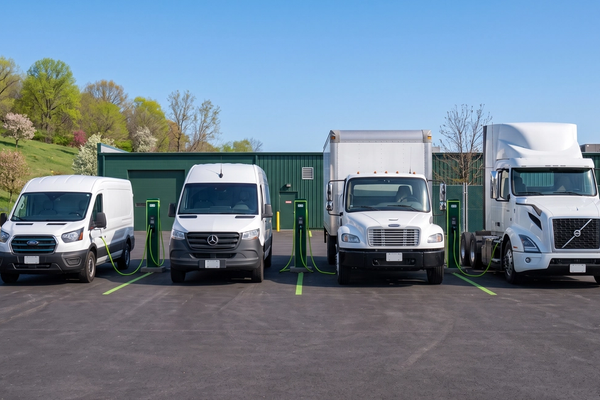
A commercial-grade Level 2 charger (the standard for overnight fleet charging) typically costs $1,500 to $5,000 per unit for the hardware itself. DC fast chargers, used for mid-shift top-ups, range from $20,000 to $100,000 or more depending on power output.
Installation costs vary significantly based on your existing electrical infrastructure. A depot with adequate panel capacity might add $1,000 to $3,000 per charging port. Sites requiring panel upgrades, trenching, or utility service upgrades can push installation fees to $10,000 to $50,000 or more for a multi-vehicle depot. Natural Resources Canada's electric vehicle infrastructure funding page outlines typical infrastructure requirements and funding programs for commercial deployments.
All-in, fleet operators should budget $7,000 to $15,000 per charging port before rebates for a well-planned Level 2 depot installation, based on 2025 commercial installation benchmarks.
Home Charging Station Costs for EV Drivers
Most EV owners and EV drivers who take company vehicles home use a Level 2 home charging station for overnight charging. Installing a Level 2 home charging station typically costs $1,000 to $3,000, including hardware and a licensed electrician. Rebates for home charging station installation are available in select provinces, reducing costs by up to $350 in BC and up to $600 in Quebec through the Roulez vert program, depending on the province and installer. For fleet operators with drivers who take vehicles home, understanding home charging costs helps set accurate reimbursement or allowance policies. According to a Natural Resources Canada study, the average annual cost of home charging for Canadians is approximately $277 per year, based on typical electricity rates of $0.10 to $0.14/kWh and average daily usage (2020 data; actual costs vary by province, vehicle, and charging habits).
Demand Charges and Time-of-Use Rates: The Hidden Ongoing Cost
Per-kWh rates tell only part of the story. Commercial electricity bills in Canada often include demand charges, which are fees based on your peak power draw in a given billing period, not just your total energy consumption. If five vans plug in simultaneously at shift end, the resulting demand spike can add hundreds of dollars to a monthly bill.
Charging during off-peak hours, where time-of-use pricing applies, is the simplest way to reduce this exposure without additional hardware. Smart charging software that staggers charging start times to flatten demand peaks is not optional for fleets. It is essential cost management. Provincial and territorial energy profiles from the Canada Energy Regulator provide rate structures by region to help fleet managers model their specific exposure to demand charges.
How Much Does It Cost to Charge an Electric Car Per Kilometre in Canada
Per-kilometre cost is the most useful metric for fleet budgeting, as it maps directly onto how you already track fuel spend. Energy consumed varies by vehicle model, load weight, and driving habits, but 25 kWh/100 km is a reliable commercial baseline.
Provincial Electricity Rates and Per-100 km Cost
Provincial electricity rates shape what your fleet pays per kilometre. Quebec and Manitoba have some of Canada's lowest commercial rates, often under $0.10/kWh, putting EV charging at roughly $2.25 per 100 km. Ontario and BC sit between $0.11 and $0.13/kWh, bringing rates to $2.75 to $3.25 per 100 km. Alberta's market-based pricing is the highest in Canada, typically $0.15 to $0.18/kWh for commercial accounts, but even there EV charging runs about $3.75 to $4.50 per 100 km, roughly one-quarter of what a diesel van spends over the same distance.
Compare these figures to a gas powered car at $1.50/L and 12 L/100 km: $18.00 per 100 km. Even in Alberta, most EV owners and fleet operators pay a fraction of equivalent fuel spend.
For a fleet vehicle with a 75 kWh battery and a realistic driving range of 300 to 400 km per charge, a single charge costs between $6 and $14 depending on your province.
Level 2 vs. Level 3 DC Fast Charger: How Charger Type Affects Your Total Cost
The choice between Level 2 and Level 3 DC fast charging shapes both your capital investment and your ongoing electricity bill. Charging speed and charging time vary significantly between the two, and so does cost.
Level 2 Charging: Best for Overnight Fleet Charging
Level 2 chargers (7 to 11 kW) are the right solution for fleets with overnight dwell time. Vehicles reach a full charge in 6 to 10 hours, and the lower power draw avoids triggering demand charges. Level 2 chargers can fully charge most commercial electric cars in 4 to 10 hours depending on battery capacity, making them the preferred choice for most EV owners and EV drivers managing daily charging needs. This is the most convenient and cost-effective approach for fleets operating single shifts.
Level 3 DC Fast Charging: Mid-Shift and Road Trip Top-Ups
Level 3 DC fast charging units (50 to 350 kW) can charge an EV to 80% of battery capacity in 20 to 60 minutes, making them appropriate for fleets with multiple shifts, high daily mileage, or limited overnight dwell time. The trade-off is significantly higher hardware investment, greater installation complexity, and real risk of demand charge spikes if not managed carefully. Level 3 fast charging is also the right option when drivers need a top-up during a road trip or an extended route outside depot range.
Home Charging vs. Public Charging Stations: What Fleet Managers Need to Know
Fleet vehicles that need top-ups mid-route can access Canada's growing network of public charging stations, including FLO and ChargePoint. According to Electric Autonomy Canada's April 2026 report, Canada now has over 14,000 publicly accessible EV charging station locations with nearly 39,000 charging ports, spread across urban centres and major travel corridors. Per-kWh rates at these stations are typically $0.25 to $0.45/kWh, notably higher than depot rates.
Understanding How You Are Billed at Public Stations
Public stations do not all bill the same way. According to Natural Resources Canada, fee-based public charging in Canada can be billed by time, by kilowatt hour, as a flat fee per use, or by a combination of these methods. Others use an hourly rate, meaning a slower charger can cost more than expected if vehicles are left connected after reaching a full charge. Idle fees are charges applied when an EV remains plugged in after charging is complete, designed to free up station availability for the next driver. Fleet managers should understand how they will be billed before relying on public networks for regular route charging.
Public charging network customers are often required to subscribe to the network for access. Typical costs range from $10 to $30 per charge depending on the level of charger used and the amount of charge needed. Unlike home charging, free charging at select public locations exists but is not a reliable planning assumption for commercial fleets.
For drivers planning routes with public charging stops, mobile apps from FLO, ChargePoint, and other networks display station details including availability, pricing, and charger type. Public charging infrastructure is expanding rapidly across North America to meet growing EV demand.
For most Canadian delivery and service fleets operating single shifts, Level 2 charging at the depot remains the most cost-effective approach: lower hardware investment, lower installation fees, and lower ongoing energy rates.
Tips for Reducing Fleet EV Charging Costs
Charge during off-peak hours. Most utilities offer time-of-use rates that are significantly lower at night. Charging during off-peak hours reduces electricity costs and is the easiest way to lower your per-vehicle charging bill without any hardware changes.
Use smart charging software. Smart charging apps manage when and how fast each vehicle charges, flattening demand peaks and optimizing energy consumption across your depot. This directly reduces demand charges on your commercial electricity bill.
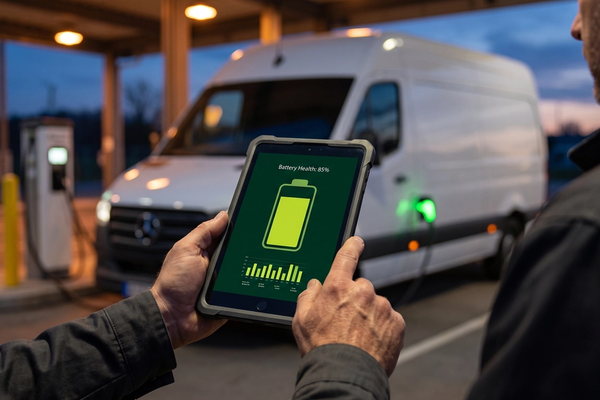
Monitor charging with telematics. Telematics systems track the EV's range, energy efficiency, and charging patterns in real time, helping fleet managers identify inefficient charging habits and optimize routes to minimize public charging needs.
Understand your billing structure. Some commercial rates are billed based on demand intervals as short as 15 minutes, meaning a brief peak can affect your entire month's bill. Knowing whether you are billed by kWh or by demand interval is critical to managing costs accurately.
For Canadian fleet operators making the transition, 7Gen builds charging infrastructure, energy management, and maintenance into a single monthly cost, so the numbers stay predictable from day one.
Use our free TCO Calculator to compare EV vs. ICE fleet costs for your operation.
Ready to Electrify Your Fleet?
Get expert guidance on transitioning to electric vehicles. Our team is ready to help.
Get a Quote