EV Charging Rates in Canada: What Fleet Managers Need to Know in 2026
Compare EV charging rates across Canada: BC, Ontario, Alberta, and Quebec. See what it costs to charge an electric fleet vehicle at a depot in 2026.
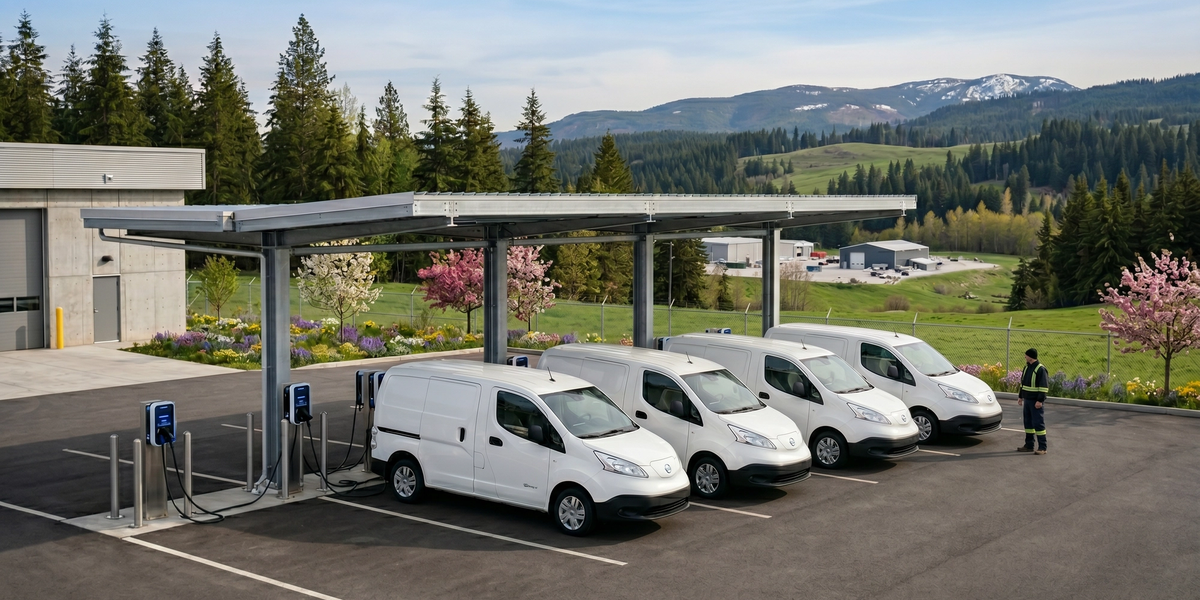
Commercial EV fleet charging station in Canada
For Canadian fleet managers evaluating the shift to electric vehicles, the EV charging rate is one of the first numbers that needs to be pinned down. What you pay per kilowatt hour depends on your province, your utility, and whether your operation has accessed a commercial fleet rate structure. The difference between an optimized approach and an unmanaged one can represent thousands of dollars per vehicle each year.
What Is the EV Charging Rate in Canada?
EV charging rates vary significantly across Canada. Quebec has the lowest rates in the country, with Hydro-Québec's Rate D charging 6.08 cents per kWh for the first tier and 9.38 cents per kWh above the daily threshold as of April 2026. In Ontario, the Ontario Energy Board's Time-of-Use plan runs from 9.6 to 18.2 cents per kWh, while the Ultra-Low Overnight plan drops to 3.9 cents per kWh between 11 p.m. and 7 a.m. In British Columbia, BC Hydro's flat rate is 12.63 cents per kWh, or 7.63 cents per kWh overnight with time-of-day pricing. Alberta operates a deregulated market where the Rate of Last Resort sits near 12 cents per kWh, with commercial rates varying by retailer and contract.
For fleet depot charging, commercial electricity rates are typically negotiated separately and fall between 6 and 15 cents per kWh across Canada, depending on province and utility.
How Do EV Charging Rates Compare Across Canadian Provinces?
The table below summarizes current rates across Canada's four largest fleet markets, sourced from official utility schedules. Commercial fleet rates vary by volume and contract structure. Use these as a starting point for rate planning.
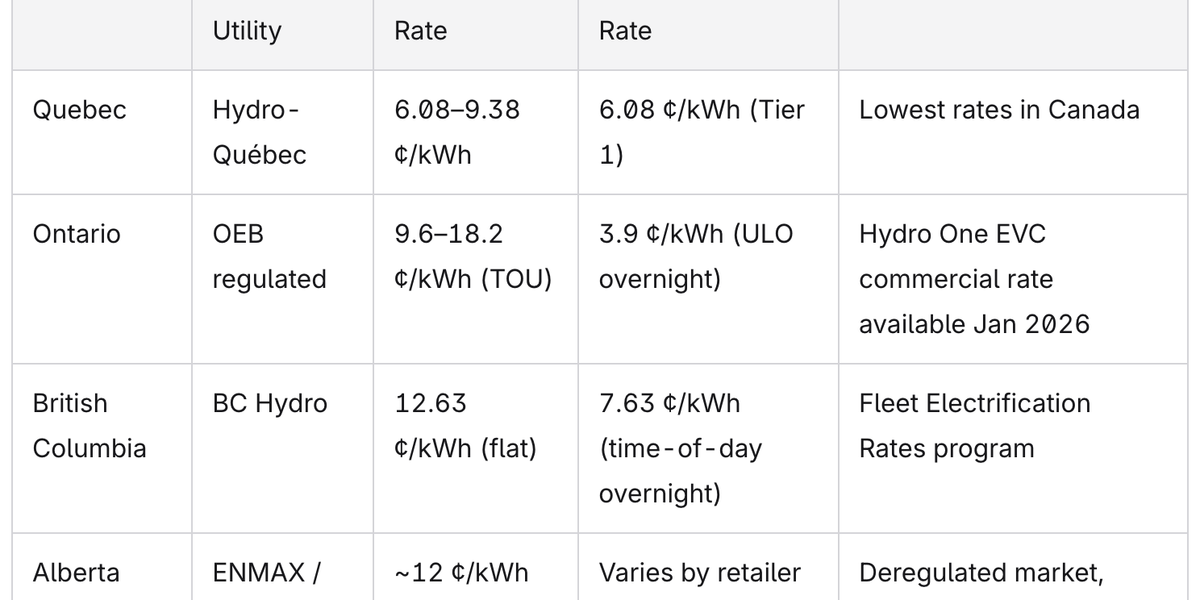
Canadian EV charging rates by province, 2026: BC Hydro, Hydro-Québec, Ontario OEB, and Alberta ENMAX
According to the Canada Energy Regulator's 2026 electricity price comparison, Quebec and Manitoba offer the lowest residential electricity prices in the country, while Alberta, Saskatchewan, and PEI tend toward the higher end. For fleets operating across multiple provinces, the spread in electricity costs between a Quebec depot and an Alberta depot is material at scale.
What Are the Different Types of EV Charging Stations?
There are three main types of EV charging stations in Canada, each with different speeds and use cases.
Level 1 charging uses a standard 120-volt outlet and delivers roughly 6 to 8 kilometres of range per hour. It suits low-mileage passenger EV owners for home charging but is not practical for commercial fleets. Several hours on a Level 1 charger adds only a fraction of what a working van requires.
Level 2 charging runs on a 240-volt alternating current (AC) supply and is the standard for fleet depot chargers and public charging stations across Canada. A Level 2 charger delivers 25 to 80 kilometres of range per hour depending on the power supplied and the electric vehicle battery's acceptance rate. A 75 kilowatt-hour (kWh) commercial van fully charges in 6 to 10 hours, fitting within an overnight window. Level 2 charging is where most EV owners do the majority of their recharging.
DC fast charging (Level 3 / DCFC) uses direct current to push power directly into the EV battery, delivering higher charging speeds of 200 kilometres or more of range per hour and reaching 80 percent charge in approximately 30 minutes. Charging speed tapers above 80 percent as the battery management system reduces current to protect battery health. Electricity fees at DCFC stations are significantly higher per kilowatt hour than at depot Level 2 chargers.
For most single-shift delivery fleets, Level 2 overnight charging at the depot covers all charging needs without DCFC on site.
What Does Public EV Charging Cost Across Canada?
EV adoption is accelerating across Canada and North America. Public charging stations are now found at grocery stores, hotels, retail locations, and along major roads. Canada has more than 6,000 public EV charging stations, and that number continues to grow.
National networks like FLO and ChargePoint charge roughly $0.25 to $0.45 per kWh. In BC, BC Hydro's public network charges 28.28 cents per kWh at Level 2 stations and approximately 36 cents per kWh at DC fast charging stations as of April 2026. Some locations offer free charging through employer or retail partnerships, but this is not a reliable planning assumption for fleet operations.
Depot charging across Canada costs 6 to 15 cents per kWh under commercial rates, making public EV charging fees two to four times more expensive per kilowatt hour. For a 75 kWh EV battery, a full charge at a public fast charging station costs $18 to $27; the same charge at a fleet depot costs $5 to $10. Over 250 operating days, that electricity cost gap adds up to $3,000 to $4,500 per vehicle per year.
How Much Does It Cost to Charge an Electric Car at a Fleet Depot?
Fleet operators with on-site Level 2 chargers pay commercial electricity rates, not public EV charging fees. For example, a delivery van consuming 25 kWh per 100 kilometres and covering approximately 40,000 kilometres per year uses around 10,000 kilowatt hours of energy annually. At a mid-range commercial rate of 12 cents per kWh (typical of BC), the numbers look like this:
- Annual energy cost per vehicle: approximately $1,200
- Daily energy cost: approximately $5 (based on 40,000 km / 250 operating days)
- Annual fuel cost for a comparable gas-powered vehicle at $1.65/L (approximate Canadian average) and 12 L/100 km: approximately $7,920
In Quebec, the same van would consume 10,000 kWh at Hydro-Québec's Tier 1 rate of 6.08 cents per kWh, for an annual energy cost of approximately $610, making the province's electricity advantage over gas even more pronounced. Across most Canadian provinces, fleet managers can save more than $6,000 per vehicle per year in fuel costs, adding up to over $120,000 across a fleet of 20 vehicles before maintenance savings and carbon credit revenue.
Unlike gas prices, which fluctuate with oil markets and vary by gas station, regulated electricity rates in most provinces change on a known schedule. That predictability makes EV charging costs easier to budget over a multi-year fleet agreement.
How Do EV Charging Station Costs Factor Into the Total Price?
The electric car charging rate per kWh is only one layer of total charging costs. Fleet managers need to track three components:
Hardware: Commercial-grade Level 2 EV chargers range from $1,500 to $5,000 per unit. Capacity requirements vary across vehicle models, so review your fleet before specifying. For most delivery fleets, Level 2 chargers cover all requirements without DCFC on site.
Installation: Budget $5,000 to $15,000 per charging port before incentives, as outlined in Natural Resources Canada's EV charging infrastructure guidance.
Demand charges: Commercial electricity bills in Canada include demand charges based on peak power draw. EV drivers all plugging in simultaneously at shift end can spike demand and add hundreds of dollars to a monthly electricity bill. Smart charging software mitigates this automatically.
How Can Fleet Managers Reduce Their EV Charging Rate?
Every major Canadian utility offers tools that reduce electricity costs for commercial fleet operators:
- Overnight rate plans: BC Hydro's time-of-day pricing drops to 7.63 cents per kWh overnight. Ontario's Ultra-Low Overnight plan reaches 3.9 cents per kWh. Quebec's Tier 1 rate applies at all hours. Scheduling EV charging between 11 p.m. and 7 a.m. captures the lowest available rate in every province.
- Dedicated fleet rate programs: BC Hydro's Fleet Electrification Rates and Ontario's Hydro One EVC Rate for commercial EV charging stations both reduce per-kWh costs and demand charge exposure for high-volume electric vehicle charging.
- Load management software: Distributes charging load across available EV chargers, keeps demand charges predictable, and enables demand response participation.
- Carbon credit programs: BC's Low Carbon Fuel Standard and Canada's Clean Fuel Regulations both allow fleet operators to generate revenue from EV charging activity, creating a partial offset against electricity costs.
Solutions like those offered by 7Gen combine infrastructure planning, rate optimization, and energy management into a single all-inclusive monthly model, whether a fleet operates in BC, Ontario, Quebec, Alberta, or across multiple provinces.
What the Right EV Charging Rate Means for Your Fleet
EV charging prices across Canada are not fixed. They depend on province, utility, time of day, and rate structure. The difference between an unmanaged depot setup and an optimized one can represent $3,000 to $8,000 per vehicle over a five-year term.
Understanding the EV charging rate picture in your province, from home charging through commercial depot rates and fleet-specific programs, is the starting point for any serious fleet electrification plan. For a full cost breakdown, see 7Gen's guide to EV charging costs for Canadian fleet managers and how electric vehicle total cost of ownership compares to diesel.
At 7Gen, we work with Canadian fleet operators from coast to coast to build the right EV charging infrastructure and rate strategy from day one, reducing the effective EV charging rate across your operation and making the business case for electrification straightforward.
→ Use our free TCO Calculator to compare EV vs. ICE fleet costs for your operation.
Ready to Electrify Your Fleet?
Get expert guidance on transitioning to electric vehicles. Our team is ready to help.
Get a Quote