Electric Fleet Operations: Why Going Electric Is No Longer a Procurement Decision
Alzbeta Lietava
Electrification Expert
Electric fleet operations, not the purchase decision, now determine whether going electric pays off. Here is what running a commercial EV fleet well takes.
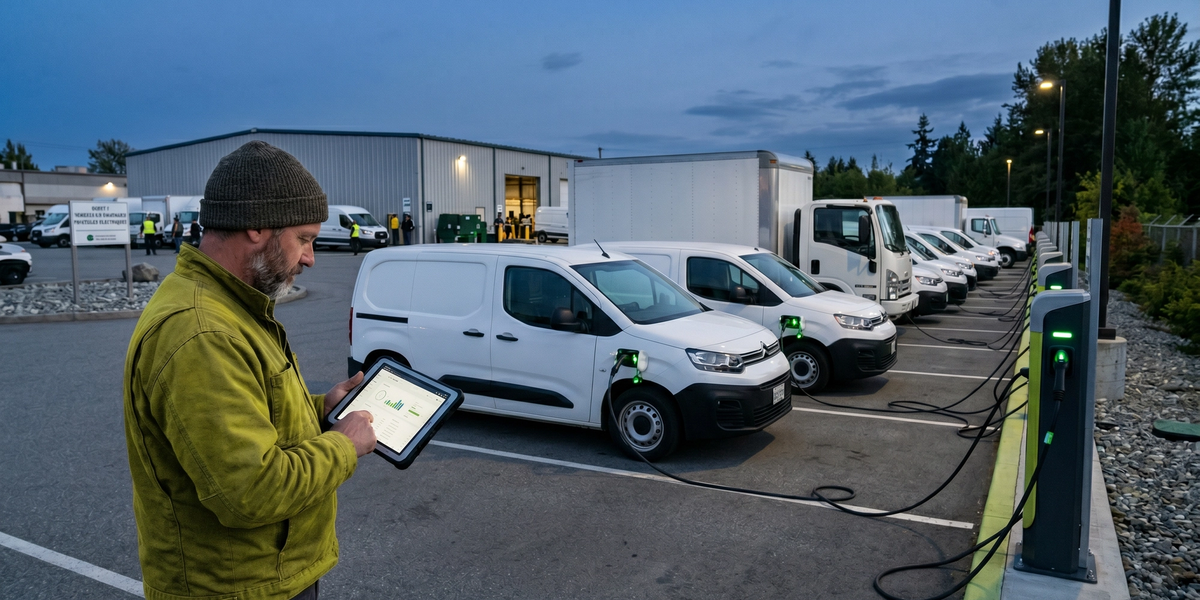
Fleet manager reviewing a charging dashboard at a Canadian depot where electric fleet vehicles charge overnight, illustrating electric fleet operations.
A few years ago, the hard part of going electric was deciding to do it. Should the fleet buy electric vehicles at all? Which models? Would the numbers work against conventional vehicles? Those questions are mostly answered now. For a growing share of commercial routes, the business case for a battery electric vehicle is clear, and the vehicles exist to serve it.
So the question has shifted. It’s no longer about whether to electrify or which vehicles to buy. The focus is now on how well you manage the fleet once the vehicles are on the road. This is where electrification succeeds or fails. Savvy fleet managers see it not as a one-time purchase, but as a daily change in how the fleet operates. The real savings come from electric fleet operations, not just the initial procurement.
Procurement was the easy part
It is worth being honest about why buying felt so big: it was new. Fleet managers were making a first-time call on unfamiliar vehicles, charging equipment, and cost structures. EVs have a higher initial purchase price than comparable ICE vehicles, so the upfront costs dominated the conversation and made the buying decision feel like the whole project.
But the purchase price is a one-time event. Operating the vehicle happens every day for years. A strong fleet electrification strategy gets procurement right, then spends most of its energy on what comes after: charging, energy, uptime, and maintenance. Get operations wrong and the promised savings never show up. Get them right and an electric fleet steadily beats the diesel fleet it replaced. Government incentives still help narrow the upfront gap, though the programs change often and several federal vehicle rebates have now wound down. A few remain genuinely useful for fleets. Natural Resources Canada's ZEVIP program still covers up to 50% of eligible charging infrastructure costs, an enhanced federal capital cost allowance lets businesses write down eligible EVs faster, and carbon credit programs, the federal Clean Fuel Regulations and the BC Low Carbon Fuel Standard, pay ongoing revenue rather than a one-time rebate. Provincial support is available in places too, including BC's fleet charging program and Quebec's Écocamionnage program for commercial trucks. Because what is open changes quickly, our guide to current Canadian EV fleet incentives tracks what is active now. Higher residual value and warranty coverage on EV batteries further protect the investment over time.
Where electric fleet operations are won or lost
Running a commercial electric fleet well comes down to a handful of areas that diesel never asked you to think about.
Charging and energy
With diesel, refuelling was simple and the price was the price. With electric, charging becomes an operational discipline. EV charging infrastructure has to be sized to your routes, and the cost of energy changes with the time of day. EV charge scheduling and energy management is where real money is made or lost. For many operators electricity is the fleet's biggest fixed cost, so charging during off-peak hours, spreading load across the depot, and managing demand charges and other fixed charges is how you control costs instead of quietly overspending on electricity costs. It pays to involve your local utility early, since installation costs, fleet size, and the geographic location of a charging site shape what infrastructure makes sense, especially for heavy duty installations.
Many fleets lean on overnight depot charging, where a Level 2 charger recharges most vehicles in about eight hours, well within an overnight window. DC fast chargers and depot charging stations can bring a battery to roughly 80% in about 30 minutes when a vehicle needs fast charging mid-shift, while public charging stays a backup rather than a daily plan (Natural Resources Canada). Matching charging units to duty cycles keeps both energy costs and infrastructure costs in check.
Uptime and route design
In an electric fleet, charging availability replaces the fuel stop, and range shapes the route. Electric fleet uptime depends on chargers that work and routes built around how the vehicles actually perform. EVs are far more efficient than combustion vehicles, between 2.6 and 4.8 times more efficient per mile according to the U.S. Department of Energy, and predictable routes with return-to-base charging are the easiest to electrify first. Heavier vehicles need more planning: Class 8 electric trucks such as the Kenworth T680E offer roughly 150 to 250 miles per charge depending on the battery, so EV range and battery management matter most on regional trucks. A vehicle that cannot charge is just as off the road as one that will not start, so the goal is to minimize downtime, not just buy capable trucks.
Maintenance
This is one of the clearest wins, and it shows up only in operations. Electric vehicles have far fewer moving parts and no oil changes, so electric fleet maintenance costs run about 40% below comparable ICE vehicles over the life of the vehicle, according to U.S. Department of Energy (Argonne National Laboratory) analysis. Less maintenance means lower maintenance costs and lower labor costs in the workshop, and that reduced maintenance accrues month after month, not at the point of purchase. Capturing it takes a maintenance approach built for EVs rather than carried over from diesel habits.
Data and telematics
None of the above works on guesswork. EV fleet telematics turn charging, energy use, battery life, and utilization into numbers a manager can act on. Good data makes battery management a routine task rather than a worry, and it is essential when running mixed fleets of electric and conventional vehicles. It shows which of your multiple vehicles are underused, which routes drain range faster than expected, and where the next dollar of savings is hiding. Without it, decisions become reactive. With it, operational efficiency keeps improving across the entire fleet.
The number that only operations can deliver
Electric fleet total cost of ownership is the figure that matters, and it is an operational result, not a purchase price. The sticker is only the opening line. The total cost includes energy costs, maintenance, uptime, residual value, and the revenue a fleet earns from carbon credits over years of running.
Each of those variables is worth modelling before you commit, and 7Gen builds free tools for it. The fleet electrification calculator bundles a TCO calculator that compares electric against diesel across financing, fuel, maintenance, and incentives, an EV range comparison that tests candidate vehicles against your real routes, and a carbon credit estimator that sizes the revenue side. The charging curve simulator models real charge times by vehicle, charger, and temperature. Each one answers an operational question that moves the final number.
The pattern is consistent. Fuelling an EV costs roughly 60% less than a gasoline vehicle on the U.S. national average (U.S. Department of Energy), so fuel savings build over the life of the vehicle. Carbon credits add a second stream: fleets that charge electric vehicles can earn and sell credits under the federal Clean Fuel Regulations and, in British Columbia, the Low Carbon Fuel Standard. 7Gen customers cut fuel and maintenance costs by around 40% in the first year, and a well-run electric fleet lands roughly 30% below the total cost of a comparable diesel fleet over its life. None of that is set at the dealership. It is earned in operations, one month at a time, and it is what gives an electrified fleet a competitive edge.
What good looks like
Operational excellence in an electric fleet is not complicated, but it is constant. It means charging infrastructure matched to real routes and duty cycles. It means energy scheduled around off-peak hours and demand charges. It means routes designed around range and depot charging, a maintenance program built for EVs, and live data guiding every call. Run those well and the fleet becomes cost effective: lower operating costs, fewer ongoing costs, cleaner running, and vehicles that stay on the road.
How 7Gen fits
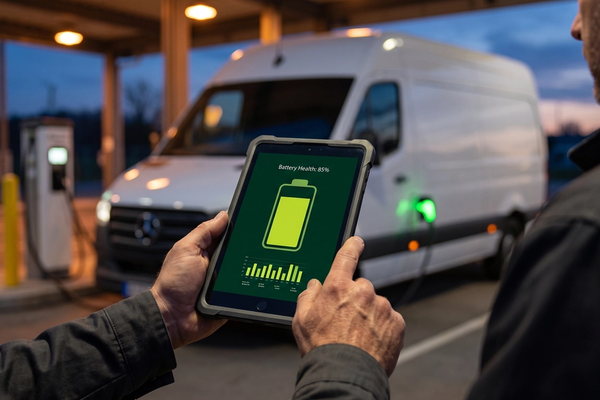
7Gen runs the operational side of electrification so fleet operators do not have to. Vehicles, charging infrastructure, EV fleet management software, and carbon credit administration sit under one contract and one monthly payment, whether you run a few fleet vehicles or own charging infrastructure across multiple depots. The 7GenOS dashboard gives a single view of utilization, energy cost, battery health, and carbon performance across every vehicle and charger, so the data that drives good electric fleet operations is in one place.
The result is simple. Operators get the savings electrification promises without taking on a second full-time job to manage it. The decision to go electric is no longer the hard part. Running the fleet well is, and that is where the right partner makes the difference.
Ready to run your electric fleet better? Get a quote from 7Gen.
Ready to Electrify Your Fleet?
Get expert guidance on transitioning to electric vehicles. Our team is ready to help.
Get a Quote