Software: What is charging management software and how could it save you time and money?
Smart charging is where EV fleet economics are won or lost. EV fleet charging management software controls demand charges, automates off-peak charging schedules, and unlocks carbon credit revenue for fleet operators. Here is what it does and how much it can save.

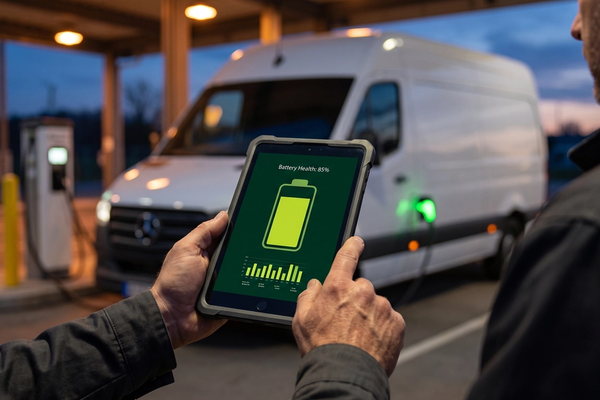
Fleet manager using EV fleet charging management software to monitor depot charging for an electric delivery van.
As electric vehicles take on a growing share of commercial fleet operations, how you charge them matters as much as which vehicles you choose. Canada will need approximately 679,000 public charging ports by 2040, according to Natural Resources Canada, and the EV fleet management market is on track to reach $32.25 billion by 2030, growing at 22.7 percent annually. Fleet managers who treat EV charging as a passive activity are leaving significant cost savings on the table.
EV fleet charging management software changes that. Here is how it works, what to look for, and how it reduces costs and saves time across your electric fleet operations.
What Is Smart Charging for Electric Vehicle Fleets?
Traditional EV charging is straightforward: plug in the vehicle and it draws maximum power from the grid until the battery reaches 100 percent. For a fleet of electric vehicles all returning to a depot at the same time, that approach creates real problems: demand charges spike, grid capacity is strained, and energy costs climb.
Smart charging applies an intelligent decision-making process that automatically adjusts power output from each charging station. EV fleet charging management software acts as the coordination layer between your vehicles, your charging infrastructure, and the electricity grid:
- Reduces total peak demand at the charging location, avoiding high demand charges
- Accounts for time-of-use (TOU) rates to charge during off-peak electricity rate windows
- Ensures vehicle availability by incorporating fleet schedules into automated charging decisions
- Supports grid stability by distributing EV charging load across available capacity
What Does It Mean for Fleet Managers and Fleet Operators?
EV fleet management software gives fleet managers the ability to monitor, manage, and control the charging of their entire electric fleet while automatically finding the most cost-effective times to charge — shifting fleet operations from reactive charging to proactive energy management.
While EV fleet management software carries a monthly or annual fee, those costs are consistently outweighed by energy savings, reduced demand charges, lower labour costs, and carbon credit revenue.
Key Features of EV Fleet Management Software
Real-time monitoring. A central dashboard shows the live state of charge and charging status for every vehicle in the fleet, giving fleet managers instant visibility without manual check-ins.
Dynamic load management and load balancing. Dynamic load management ensures the total power draw from all EVs charging at a depot stays within the site's electrical capacity. The software automatically distributes available power across active chargers in real time, routing energy to the vehicles that need it most. Our partner Ampcontrol helped a client achieve a 45 percent reduction in peak power demands using dynamic load balancing, significantly cutting monthly energy bills.
Automated scheduling and charging schedule optimization. Automated scheduling coordinates charging sessions based on vehicle duty cycles, departure times, and energy cost windows. Fleet depot charging becomes highly efficient here: linking charging schedules with route management allows fleet operators to adjust vehicle availability windows to align with grid-friendly charging times, ensuring vehicles are ready without paying peak electricity rates to get there.
Telematics integration. EV fleet management software connects directly to vehicle data, synchronizing charging schedules with route availability and actual vehicle state of charge so charging decisions are based on real operational data.
Predictive maintenance. Modern EV fleet management software uses AI to analyze patterns in energy usage and vehicle diagnostics, flagging potential failures before they affect fleet operations. Fleet managers receive alerts when charging behaviour or battery performance deviates from baseline, reducing unplanned downtime and lowering maintenance costs.
Access control and OCPP compliance. Access control restricts charger usage to authorized personnel via RFID or mobile app. Open Charge Point Protocol (OCPP) compliance ensures the software is hardware-agnostic, preventing vendor lock-in and supporting chargers from multiple manufacturers on one platform.
Mobile driver apps. Drivers can locate available chargers, monitor their charging session, and receive notifications on which charger to use and when — keeping fleet operations moving on schedule.
Comprehensive reporting and analytics. The software tracks energy consumption, session duration, and total cost of ownership data for every vehicle and charger. Detailed analytics support sustainability reporting, budget planning, and government incentive qualification.
How EV Fleet Charging Management Software Reduces Energy Costs
Demand charges and demand response. Demand charges are calculated on the highest 15-minute peak power draw in a billing period. A fleet of electric vehicles plugging in simultaneously can trigger charges that persist for the entire month. EV fleet charging management software spreads charging load across the available window rather than concentrating it at plug-in time, keeping peak demand within contracted capacity and enabling participation in utility demand response programs.
Off-peak electricity rates. Overnight charging using off-peak electricity rates can reduce charging costs by 35 to 60 percent compared to daytime charging. EV fleet management software automates this scheduling without requiring depot staff to be on-site overnight.
Carbon credit revenue. Fleet operators can generate revenue through carbon credit programs. In British Columbia, the Low Carbon Fuel Standard (LCFS) allows fleets to earn credits for EV charging activity. At the federal level, Canada's Clean Fuel Regulations allow private fleet operators and charging network operators to create and sell compliance credits, with credit prices rising sharply since 2023. EV fleet management software tracks and reports the data needed to register and monetize these credits.
Renewable energy integration. Smart charging systems can schedule EV charging to coincide with periods of high renewable energy generation, further reducing both energy costs and fleet emissions.
Infrastructure cost savings. Dynamic load management allows fleets to operate within existing electrical capacity, avoiding costly grid upgrades that would otherwise be required to support simultaneous charging across a large fleet.
How EV Fleet Management Software Saves Time
Connecting your charging infrastructure to fleet management software can be completed within days — Ampcontrol connected real-time software to 50 chargers for a client in under one day. Remote monitoring eliminates after-hours on-site staffing: fleet managers can run diagnostics and restart chargers through an app before drivers arrive. When fleet vehicles outnumber charging stations, automated scheduling determines which vehicles charge first based on duty cycle data, removing manual coordination entirely.
The Total Cost of Ownership Case
Electric vehicles already offer significant total cost of ownership advantages over ICE vehicles through lower fuel and maintenance costs. EV fleet management software extends those advantages: studies indicate EVs deliver 8 to 13 percent total cost of ownership savings at the fleet level when managed effectively, and smart charging is central to achieving that. Comprehensive reporting gives fleet managers the data needed to demonstrate ROI, qualify for government incentives, and plan for long-term fleet electrification. For a full breakdown of how to build the financial case for your fleet, see 7Gen's Fleet Electrification ROI guide.
Conclusion
EV fleet charging management software is not a nice-to-have. It is how fleet managers control energy costs, maintain vehicle availability, and generate carbon credit revenue at scale. At 7Gen, we work with trusted partners like Ampcontrol to give clients access to reliable, flexible EV fleet management software as part of a complete fleet electrification solution.
To find out how 7Gen's end-to-end EV fleet solutions can simplify charging management and reduce operating costs for your fleet, get in touch with our team today.
Ready to Electrify Your Fleet?
Get expert guidance on transitioning to electric vehicles. Our team is ready to help.
Get a Quote