CFR Credit Price in 2026: What Canada's Carbon Market Means for Your Fleet
Alzbeta Lietava
Electrification Expert
CFR credit prices crossed $400 in 2026. Here's how Canada's carbon pricing works now and what clean fuel credits are worth to an electric fleet.
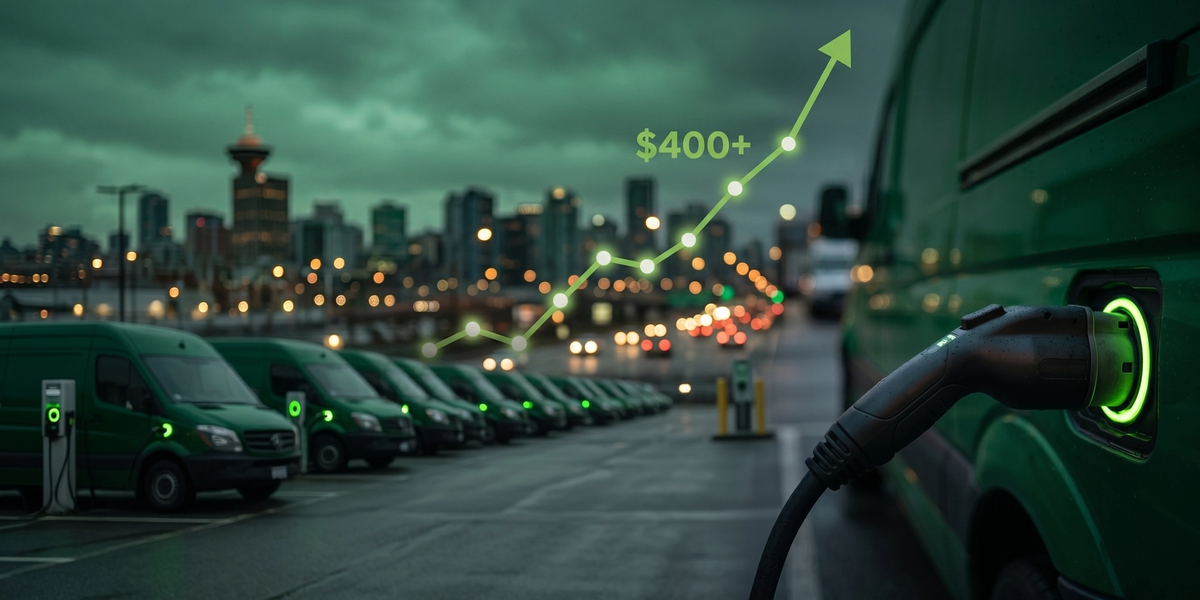
A line of electric vans charging at a depot, with a rising line graph above them.
If you manage a commercial fleet in Canada, "CFR credit price" has probably crossed your desk. It is one of the few carbon numbers that lands directly on a fleet's bottom line. In early 2026, federal Clean Fuel Regulations (CFR) credits traded north of $400 each for the first time. That number changes the math on electrification, so it is worth understanding what sits behind it.
Carbon pricing in Canada shifted a great deal over the past year, and a lot of what you may have read about the price of carbon, the carbon tax, the carbon levy, and rebates no longer applies. Here is where things actually stand, and where CFR credits fit.
How Industrial Carbon Pricing Drives Your Credit Revenue
While consumer-facing carbon taxes at the pump dropped to $0, industrial carbon pricing is still fully in place—and it is the exact engine driving up the cash value of your fleet’s credits.
The system works in your favor for one simple reason: While consumer-facing carbon taxes at the pump dropped to $0, industrial carbon pricing is still fully in place—and it is the exact engine driving up the cash value of your fleet’s credits.
The system works in your favor for one simple reason: it forces large polluters to buy the assets your electric fleet creates.
- The Penalty: In 2026, the federal industrial carbon charge sits at $110 per tonne (and is scheduled to climb to $170 by 2030). Large industrial emitters face massive financial penalties if they over-pollute.
- The Demand: To avoid these steep fines, heavy industries and fuel suppliers must buy compliance credits to offset their emissions.
The bottom line: Forget the consumer tax confusion. Industrial carbon pricing keeps the demand for compliance instruments sky-high. By running an electric fleet, you are actively generating the exact high-value asset these large companies are legally forced to buy.
How Canada's carbon pricing evolved
It helps to know how the system got here, because the language around it has not caught up to the 2025 changes.
- The federal system (2016–2019): Canada's federal carbon pricing system grew out of a national climate plan to fight climate change. The Greenhouse Gas Pollution Pricing Act passed in 2018, and at the federal level the carbon price took effect in 2019 at C$20 per tonne, rising each year as a centrepiece of federal climate policy.
- The consumer side (the "federal carbon tax"): the federal fuel charge applied to gasoline, diesel, natural gas, and other heating fuel at gas stations and on home heating bills. This carbon tax program was broadly revenue neutral: direct proceeds came back through the Canada Carbon Rebate, earlier the climate action incentive payment, as quarterly deposits to a bank account, with more for a spouse or common-law partner and each child, so lower-income households generally received more than they paid. Small businesses got a share through tax credits. It added modestly to consumer prices, separate from ordinary fuel taxes.
- The provinces: British Columbia's carbon tax, the first in North America, began at $10 per tonne in 2008. Quebec priced carbon from 2007 and moved to cap and trade in 2013, the only such system. Alberta priced industrial emissions as early as 2007. New Brunswick, Nova Scotia, Prince Edward Island, and others shifted between federal and provincial carbon tax systems, so coverage varied across provinces and territories.
- Today: Canada announced the end of the consumer charge, which dropped to $0 on April 1, 2025. What remains is the industrial layer: output-based pricing for the largest emitters, covering sectors like electricity generation and driving emissions reductions through to 2030. Environment and Climate Change Canada administers the system, and bodies such as the Canadian Climate Institute track how these carbon pricing schemes perform.
CFR credits vs. the carbon tax: clearing up the confusion
A CFR credit is not a carbon tax payment or a consumer rebate. Carbon pricing charges polluters per tonne of greenhouse gases they emit. The Clean Fuel Regulations require fuel suppliers to reduce the carbon intensity of the fuels they sell.
That distinction is where the opportunity lives. A carbon price is a cost for emitters. A CFR credit, by contrast, is an asset, and fleets that run on electricity are well positioned to create it.
What a CFR credit actually is
The Clean Fuel Regulations require fuel producers and importers to reduce the carbon intensity of the fuel they supply each year. The requirement tightens over time. Suppliers that cannot cut intensity fast enough need credits to stay compliant.
Those credits have to come from somewhere. One source is transportation that runs on electricity instead of fossil fuel. Every kilometre an electric vehicle drives on grid power displaces diesel or gasoline, and that displacement generates CFR credits, alongside offset credits available in other programs. Charge an electric fleet, and you produce exactly the compliance instrument fuel suppliers are short of.
That is the link between a policy aimed at refiners and a delivery van in your depot. The fleet creates the credit; the fuel supplier buys it.
What the CFR credit price is in 2026, and why it moved
For most of the program's early life, CFR credits traded in a modest range. Through 2025 and into 2026 the price climbed sharply, crossing $400 per credit for the first time in early 2026.
The driver is simple supply and demand. Carbon intensity requirements on fuel suppliers tighten every year, so demand for credits rises. Supply has not kept pace, and regulatory stringency restricts how easily new credits enter the market. When buyers compete for a limited pool of compliance credits, the price goes up. Electrification has become the main engine on the supply side, but it has not yet caught up to demand.
For a fleet operator, the takeaway is not the exact daily price. It is the direction and the scale. A credit worth $400 is a materially different asset than one worth $100, and it turns charging from a cost line into a revenue line.
What this means for fleet ROI
A high CFR credit price changes three things in an electrification business case.
- It adds a revenue stream. Charging your vehicles produces credits you can sell, and at current prices that revenue is meaningful rather than incidental. For some vehicle types it can reach several hundred dollars per vehicle each month.
- It reduces dependence on rebates. Purchase incentives come and go, with funding windows that open and close. Credit revenue is tied to how much you actually drive on electricity, so it scales with use rather than with a government budget cycle.
- It rewards utilization. The more you charge and drive electric, the more credits you generate. That puts the financial case and the operational case on the same side: a well-used electric fleet earns more.
None of this depends on a single price holding. Even well below the 2026 peak, credit revenue improves total cost of ownership against a diesel or gasoline equivalent. The price simply determines how large the upside is.
Turning credits into revenue
The catch is administration. Generating CFR credits means registering with the federal program, metering electricity use accurately, running the calculations, passing third-party verification, and finding buyers in a market that moves daily. Miss a step and the revenue does not materialize. Credits also cannot be claimed retroactively, so every month without proper tracking is money left on the table.
This is the part 7Gen handles. Alongside vehicle leasing, charging infrastructure, and fleet software, 7Gen manages the full carbon credit lifecycle: registration, energy monitoring, credit generation and verification, and selling credits when the market is strong. The fleet charges its vehicles, and 7Gen turns that into credit revenue without the administrative load landing on your finance team.
At north of $400 a credit, the question for most Canadian fleets is no longer whether the economics of electrification work. It is how much of that value you are set up to capture.
To see the numbers for your own operation, 7Gen's Carbon Credit Revenue Estimator and TCO Calculator put real figures against your vehicle mix, or get a quote.
Frequently asked questions
Is the carbon tax still in effect in Canada?
The consumer fuel charge is not. It dropped to $0 on April 1, 2025, so there is no longer a federal carbon tax on the gasoline, diesel, or natural gas that households buy. Industrial carbon pricing continues. Large emitters still pay under the Output-Based Pricing System, where the federal excess emissions charge is $110 per tonne in 2026 and is legislated to rise toward $170 per tonne by 2030, a trajectory Ottawa is reviewing this year.
When did carbon pricing start in Canada?
The federal carbon pricing system was set in motion by a national framework in 2016, the Greenhouse Gas Pollution Pricing Act passed in 2018, and the federal fuel charge took effect in 2019 at C$20 per tonne. Provinces moved earlier: Alberta was the first jurisdiction in North America to price large-emitter emissions, in 2007; Quebec introduced a carbon levy in 2007 and shifted to cap and trade in 2013; and British Columbia's carbon tax began in 2008 at $10 per tonne.
How much of global emissions does carbon pricing cover?
Nearly 30 per cent of global greenhouse gas emissions are now covered by a direct carbon price across 87 implemented policies, and carbon pricing raised more than $107 billion for public budgets in 2025, according to the World Bank. Every large middle-income economy has now implemented or is planning a carbon price. The EU Emissions Trading System remains the global benchmark, and carbon prices vary widely between compliance markets and the voluntary carbon market, where high-quality projects command a price premium.
Does carbon pricing actually reduce emissions?
Evidence says yes. The Canadian Climate Institute found that industrial carbon pricing is the single biggest driver of emissions reductions in Canada, projected to deliver between 23 and 39 per cent (53 to 90 megatonnes) of avoided emissions by 2030, well above the former consumer fuel charge's 8 to 9 per cent. Studies of British Columbia's carbon tax have also linked it to lower emissions since 2008.
What is the CFR credit price right now, and how do fleets earn credits?
Federal Clean Fuel Regulations credits traded above $400 each in early 2026, up sharply from prior years as carbon intensity requirements on fuel suppliers tightened faster than credit supply. Fleets earn these credits by charging electric vehicles: every kilometre driven on electricity instead of diesel or gasoline generates a credit that suppliers buy for compliance. 7Gen manages that full lifecycle, from registration and metering to verification and sale.
Ready to Electrify Your Fleet?
Get expert guidance on transitioning to electric vehicles. Our team is ready to help.
Get a Quote