Canada’s CFR Credits Hit Historic $400 Milestone: What This Means for EV Fleet ROI
CFR credit prices crossed $400 in 2026. See what a credit is worth, why the price moved, and how your EV fleet turns clean kilometres into revenue.
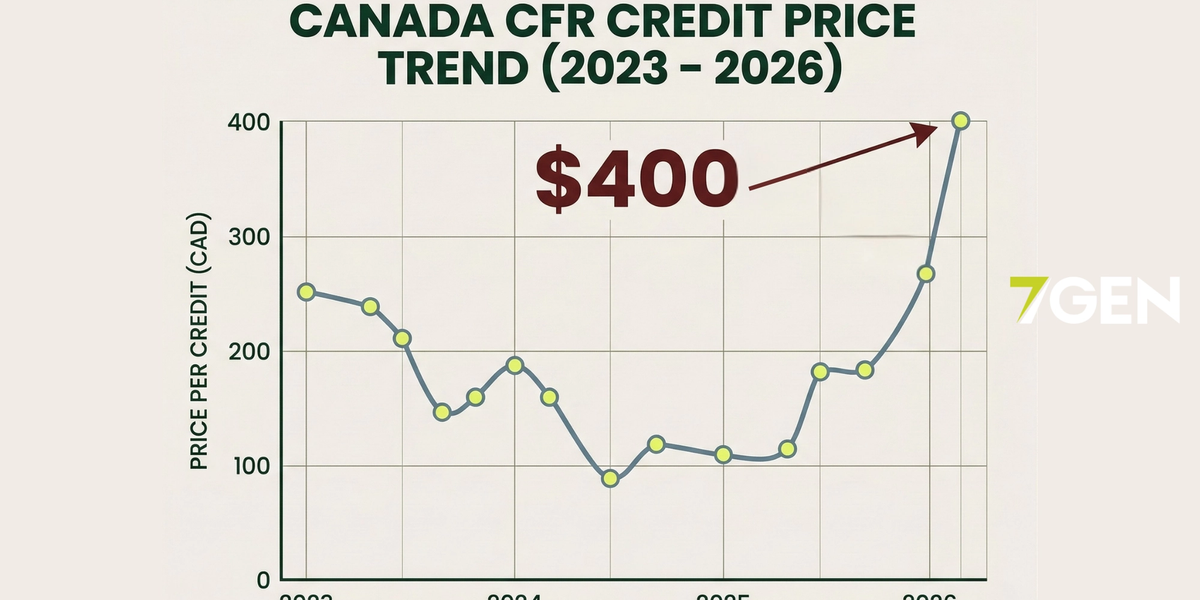
A graph showing the upward trend of carbon credit pricing in Canada.
The Canadian carbon market reached a fever pitch this morning. For the first time since the inception of the Clean Fuel Regulations (CFR), federal credit prices have officially crossed the $400 per credit threshold.
According to Seemant Karki, Director, Decarbonization at 7Gen, this isn't just a number, it's a signal. "Federal CFR credit (for the first time) has crossed $400 a piece according to market reports this morning." Karki noted. "We will be watching closely to see how the CFR market continues to develop in the months ahead!"
Why Are CFR Prices Skyrocketing?
The steady climb in credit prices reflects a tightening market. As fuel suppliers face increasingly aggressive carbon intensity requirements, the demand for high-quality compliance credits has outstripped supply.
This price surge highlights two critical market realities:
- Tightening Compliance: Primary fuel suppliers are working harder to meet federal mandates.
- The Role of Electrification: With low-carbon fuel solutions playing a vital role in decarbonizing transportation, electrification has become the primary engine for credit generation.
How This Benefits 7Gen Customers
For fleet operators, this price milestone transforms the economic math of electrification. High credit values directly translate to:
- Higher Revenue Potential: More value per credit generated means a faster path to profitability.
- Better Project Economics: Elevated credit prices can effectively "top off" or even replace traditional government incentives.
- Boosted ROI: Maintaining a strong Return on Investment (ROI) for EVs and charging infrastructure despite rising equipment costs.
- Incentivized Utilization: Higher prices encourage fleets to maximize charger utilization to capture every available dollar.
The Path Forward: A Maturing Market
This $400 milestone signals that the CFR market is maturing into a cornerstone of Canada's clean fuel policy. For fleets, the message is clear: properly tracking and monetizing your credits is no longer "optional." It is a core business strategy.
What the Clean Fuel Regulations Actually Are
Canada's Clean Fuel Regulations (the CFR program) are a federal policy from Environment and Climate Change Canada that lowers the carbon intensity (CI) of the transportation fuels used across the country. The essentials:
- The target: a 15 percent cut in average carbon intensity below 2016 levels by 2030, supporting Canada's wider emissions reduction targets on climate change.
- The impact: reducing greenhouse gas emissions from gasoline and diesel is projected to prevent roughly 26 million tonnes of emissions.
- The timeline: reduction requirements began on July 1, 2023 and tighten every compliance period through 2030.
- The fuel rule: gasoline must contain at least 5 percent low carbon intensity fuel and diesel at least 2 percent, a minimum carried over from the earlier Renewable Fuels Regulations.
How credits work
One carbon credit represents one metric ton of carbon dioxide equivalent (CO2e) reduced. Primary suppliers, mainly the gasoline and diesel suppliers who produce or import fossil fuels, carry annual reduction requirements and compliance obligations.
They can meet those obligations by:
- Lowering the CI of their own fuel through cleaner fuel production
- Supplying low CI fuel and renewable fuels such as renewable diesel and renewable natural gas
- Providing low-carbon feedstocks or converting organic waste into biofuels
- Investing in advanced vehicle technology and clean technologies such as carbon capture
- Buying compliance credits from credit creators
Suppliers that fall short become deficit generators and must acquire credits to balance their compliance reports. Every credit is registered in the federal Credit and Tracking System (CATS), where credit creation, transfers, and retirements are reported and tracked.
Why this drives prices up
As annual reduction requirements rise and the supply of low CI fuel stays tight, more buyers compete for each credit. Those credit market dynamics are the force behind the move past $400, and they make the CFR credit price in Canada one of the most watched numbers in the clean fuel sector.
Higher operating costs for fossil fuel suppliers also tend to flow through to the pump. Federal estimates suggest the CFR could add up to roughly 17 cents per litre to gasoline and 16 cents to diesel by 2030 as the program reaches full stringency. For fleets running on electricity instead, that same pressure works in your favour.
How Your Fleet Earns Carbon Credits from EV Charging
Electric vehicle charging is one of the cleanest ways to generate credits under the CFR. When you charge a commercial EV instead of fuelling a diesel or gasoline equivalent, the electricity supplied displaces a higher carbon fuel, and that displacement creates tradable credits.
The opportunity is significant. The transportation sector accounts for about 22 percent of Canada's greenhouse gas emissions and is the country's second largest emitting sector, so every kilometre moved onto electricity carries real value.
What this looks like in practice:
- Fleets that operate EV charging stations and smart EV chargers, at a depot, across commercial properties, or at retail locations, earn credits tied to the electricity their vehicles actually use.
- Higher charger utilization means more electricity supplied, which means more credits and more carbon credit revenue.
- As a rough sense of scale, a single commercial electric vehicle can draw on the order of 8,750 kWh of charging a year, and charging can be billed per session or per kilowatt-hour.
- In British Columbia, the province runs its own Low Carbon Fuel Standard, and provincial programs like it can let eligible operators stack provincial and federal credits from the same charging activity.
One important catch: you cannot claim credits retroactively. Program eligibility depends on your charger hardware and how its data is reported, and credit generation only starts once your charging is properly registered and metered. The sooner your EV charging infrastructure is set up correctly, the sooner the revenue stream begins.
What the $400 Price Means for Your Numbers
Credit price is the lever that turns charging into income. At an average credit price near or above $400, the carbon credit earnings from a single commercial EV can offset a meaningful share of its energy and operating costs, and the math improves with every vehicle you add.
Prices have climbed toward the compliance fund ceiling, the regulated cap on how high credit values can go. That tells you demand is strong and the CFR credit market is maturing rather than cooling.
The practical takeaway: size the opportunity for your own operation rather than rely on a headline number. Two free tools make that quick:
→ Estimate your carbon credit revenue with our free Carbon Credit Revenue Estimator.
→ Compare EV vs. ICE fleet costs with our free TCO Calculator.
Frequently Asked Questions
What is the CFR credit price in Canada right now? Federal CFR credit prices crossed $400 per credit in early March 2026, the first time they have done so since the regulations began. Prices move with supply and demand and have been trending toward the compliance fund ceiling.
What is one CFR credit worth? Each credit represents one metric ton of carbon dioxide equivalent reduced. Its dollar value is set by the market, which recently moved past $400 per credit.
How does an EV fleet generate carbon credits? Charging electric vehicles displaces gasoline and diesel, which lowers carbon intensity and creates credits. The electricity supplied to your fleet is measured, verified, and registered in the federal Credit and Tracking System (CATS), then sold to suppliers who need credits for compliance.
When did the Clean Fuel Regulations take effect? The carbon intensity reduction requirements began on July 1, 2023, and increase each year toward the 15 percent reduction target for 2030.
Related reading: Unlocking the Economics of EV Fleets with Carbon Credits
Ready to Electrify Your Fleet?
Get expert guidance on transitioning to electric vehicles. Our team is ready to help.
Ready to Electrify Your Fleet?
Get expert guidance on transitioning to electric vehicles. Our team is ready to help.
Get a Quote