The EV Charging Curve Simulator Built for Commercial Fleet Planning in Canada
Model real charge times for your commercial EV by vehicle, charger type, and temperature. Free tool from 7Gen for Canadian fleet managers.
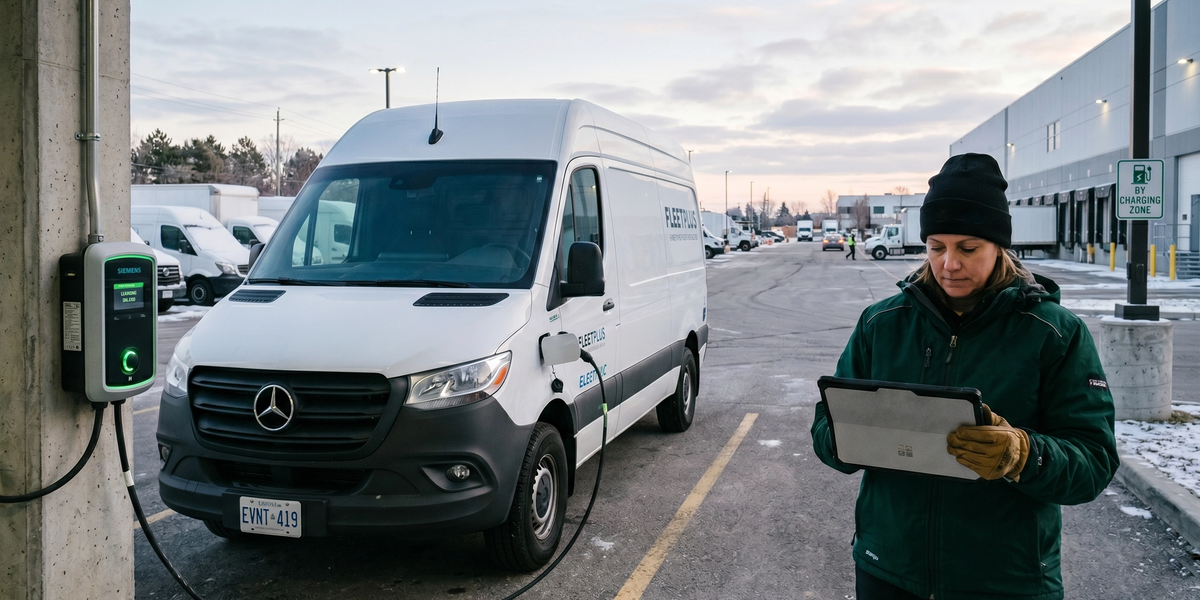
Fleet manager checking EV charging data at a commercial depot, Mercedes eSprinter on Level 2 charger.
Most fleet managers planning a switch to electric vehicles hit the same wall at some point. The spec sheet says 300 km of driving range. The EV charger at the depot puts out 9.6 kW. The shift starts at 6 a.m. Will the van be ready?
Understanding EV charging goes well beyond reading a brochure figure. The time required to charge an electric vehicle varies depending on several factors, including battery size, state of charge, maximum vehicle charging rate, and the power output of the charging station. Key factors such as an electric car's battery capacity, ambient temperature, and charger type determine how much power a vehicle will accept and what the electric vehicle's charging time will actually be. A physics-based simulation delivers real numbers before you commit to a depot infrastructure plan.
7Gen built the EV Charging Curve Simulator for this exact problem. It is free, runs in your browser, and models real-world charge behaviour for 18 commercial EV models across vans, box trucks, and heavy-duty trucks. Set the vehicle, charger type, ambient temperature, and state of charge window. The simulator returns the full charging curve and a complete session breakdown.
What Is an EV Charging Curve?
A charging curve plots how quickly a battery electric vehicle's EV battery accepts power over time, expressed as state of charge against minutes elapsed. Vehicle charging behaviour does not stay constant across the EV's battery capacity. The curve is not linear.
Power intake is typically fastest at low state of charge, between roughly 10% and 60%. As the battery approaches 80% to full capacity, the battery management system begins tapering the maximum charging rate to protect battery health. Above 80%, charging speeds drop and cell balancing begins. The shape of this curve, not just battery size, is what determines when a vehicle is actually ready for its next shift.
For fleet depots planning overnight charging windows or operations scheduling midpoint stops on longer routes, understanding the curve is what separates a workable plan from one that leaves vehicles short.
EV Charger Types: Level 1, Level 2, and DC Fast Charging
Charging time for electric vehicles varies based on several key factors: battery size, state of charge, maximum charging rate, and the power output of the charging station. The simulator covers the full spectrum.
Level 1 (AC, 1.4 to 3.6 kW): A standard 120V outlet delivers between 3 and 6 kW per hour of charging, translating to about 6 to 8 km of driving range per hour. Too slow for most commercial fleet applications.
Level 2 (AC, 7 to 22 kW): Level 2 chargers operate on a 240V outlet and charge an electric vehicle roughly seven times faster than Level 1, delivering between 7 and 22 kW and allowing 45 to 60 km of range per hour. A 9.6 kW Level 2 unit restores roughly 28 km per hour. Running at 19.2 kW doubles that rate for vehicles with larger batteries and higher AC acceptance.
Level 3 / DC fast charging (50 kW to 350+ kW): Level 3 chargers, also known as DC fast chargers, use direct current at 480 volts and can charge capable EVs in as little as 28 minutes, making them ideal for quick recharging on longer routes. DC fast chargers can deliver power from 30 kW to over 360 kW, significantly reducing charging time compared to Level 1 and Level 2 units. The simulator covers DC charging from 50 kW through 1,000 kW, including the Tesla Semi model at 750 kW peak.
EV chargers at AC speeds suit overnight fleet depot use. A fast charger at highway corridors or urban EV charging stations handles on-route top-ups for longer duty cycles.
What the EV Charging Curve Simulator Shows You
Set the vehicle, charger, temperature, and state of charge window and the simulator returns:
- Total charging time for your selected segment
- Energy added in kWh and average power delivery
- Range gained and range added per hour of charging
- Full 0 to 100% time, including cell balancing
- Effective peak power and pack temperature at session start
Example: a Mercedes eSprinter Extended (113 kWh, LFP chemistry) on a 9.6 kW Level 2 charger, starting at 10% and targeting 80%, in a 5°C environment charges for 8 hours 14 minutes, adds 79.1 kWh, and delivers 232 km of driving range, well within maximum driving range for most urban routes. Full charge to 100% takes 12 hours 8 minutes, with 57 minutes of cell balancing.
Which Commercial EVs Are Covered?
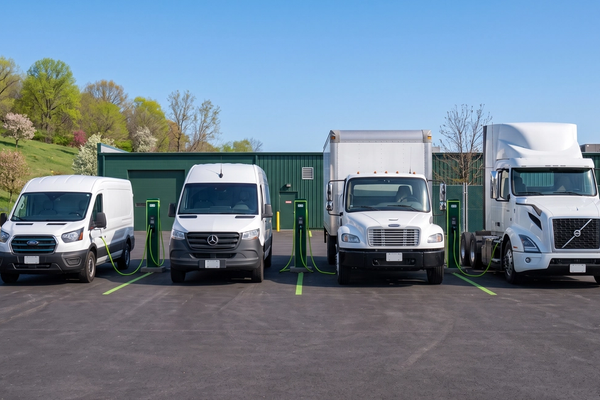
Vans: BrightDrop Zevo 600 (Standard and Max), Ford E-Transit 2024+, Mercedes eSprinter (Standard and Extended), Ram ProMaster EV
Box Trucks: RIZON e-M and e-L, Isuzu NRR EV (100 kWh and 180 kWh), Peterbilt 536EV
Heavy-Duty: Peterbilt 537EV and 548EV, Freightliner eCascadia (291 kWh and 438 kWh), Volvo VNR Electric (375 kWh and 565 kWh), Tesla Semi
That covers the commercial EV models most fleet operators are actively evaluating or already running.
EV Charging Costs and Electricity Rates
EV charging costs in Canada range from $0.10 to $0.30 per kilowatt-hour on a fleet depot Level 2 unit, depending on the province and utility rate. Charging costs run as low as $2.25 per 100 km, compared to approximately $20 for diesel over the same distance. A typical commercial EV with a 75 kWh battery costs roughly $7 to $22 to fully charge, on a per vehicle basis. Hardware and installation for a commercial EV charging station runs $5,000 to $15,000 per unit before incentives, depending on site requirements.
Commercial electricity bills in Canada often include demand charges, which are fees based on peak power draw, adding to the overall cost of charging. Scheduling sessions during off-peak hours helps, and dynamic load management tools automate power distribution across chargers to prevent overloading on-site electrical capacity and avoid costly infrastructure upgrades, reducing those costs by 30 to 50%.
For a breakdown of electricity rates by province, the real cost of EV charging for Canadian fleets covers the numbers in detail.
How Accurate Is the Data?
Charging behaviour varies depending on environmental conditions such as pack age, charger firmware, and actual ambient temperature. Advanced simulators integrate environmental factors such as battery temperature and traffic conditions to refine charging time predictions, improving the reliability of EV operations in diverse conditions.
The curves combine OEM published specifications, third-party logged sessions where available, and physics-based modeling using Arrhenius scaling and lithium plating thresholds. In Canada, EV charging curve simulators are essential for commercial fleets to handle extreme weather impacts on EV battery performance and minimize high electricity costs. Charging strategies for commercial fleets involve simulating charging curves to optimize energy demand, analyze grid constraints and vehicle schedules, and avoid peak utility charges. Real-world results vary depending on conditions.
How to Run a Simulation
Go to 7Gen's calculator page, select the Charging Simulator, and set four inputs:
- Select your vehicle from the dropdown
- Set charger capacity (AC for overnight depot; DC for on-route fast charging)
- Set ambient temperature for your operating environment
- Set start and target state of charge
The output populates immediately. Advanced options allow further refinement.
Run the Numbers for Your Fleet
The EV charging curve simulator commercial fleet Canada needs for serious planning decisions is now live and free. No sign-up required. Fleet EV owners and fleet operators can model their specific vehicles under real operating conditions before committing to infrastructure.
Solutions like those offered by 7Gen go beyond the tool. The team builds charging infrastructure, coordinates depot installation, and structures full-fleet analyses for EV owners making the transition. Try the EV Charging Curve Simulator and see what your vehicles look like under your conditions. If the numbers raise questions about your depot setup or vehicle selection, get in touch with the 7Gen team.
Ready to Electrify Your Fleet?
Get expert guidance on transitioning to electric vehicles. Our team is ready to help.
Get a Quote