Electric Vehicle Range Comparison for Fleet Managers: Choosing the Right EV for Canadian Routes
Range anxiety is the most cited barrier to fleet electrification, but for most Canadian commercial operations, it's a planning problem, not a range problem. Here's how to compare EV models against your actual routes, loads, and winter conditions.
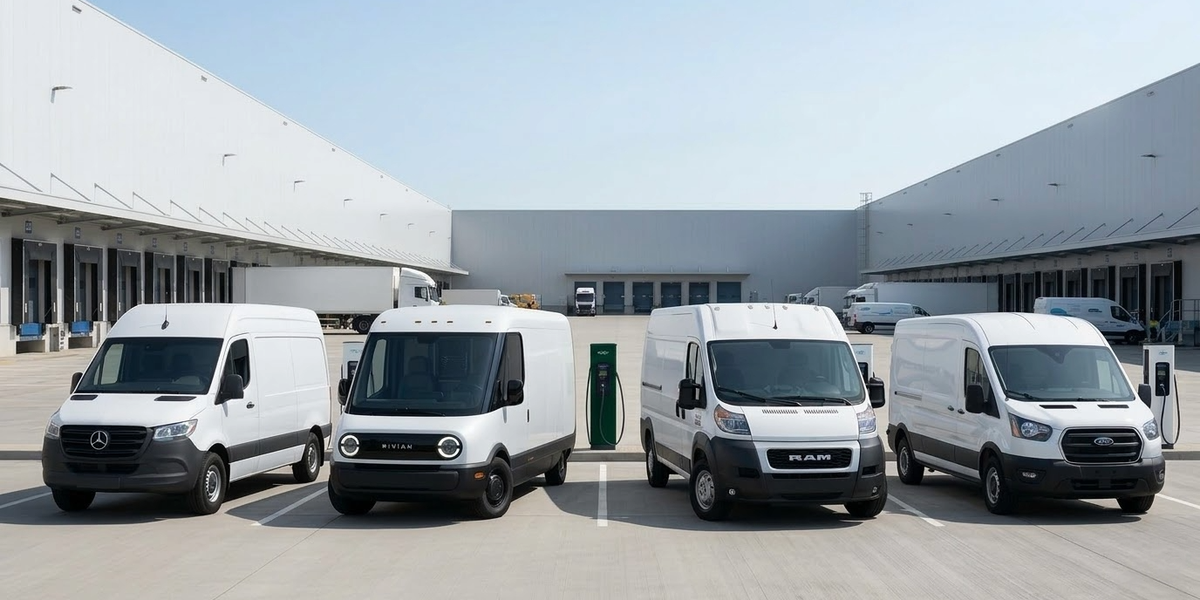
A range of electric vans
Choosing the right EV for a commercial fleet is not about finding the model with the highest number on a spec sheet. A practical range comparison for commercial EVs looks at how different vehicle classes and models perform on real Canadian routes, under real driving conditions, with real cargo loads. For fleet managers evaluating whether electrification makes sense for their operation, range is the starting point but rarely the deciding factor.
Comparing EV range for fleet purposes must account for real-world Canadian conditions, including winter range reduction of 20 to 40% in low temperatures. The most efficient electric vehicle for a given fleet depends on daily route distances, load requirements, and access to depot charging, not peak rated range alone.
1. Range Anxiety in Fleet Operations: Separating Fact from Fiction
Range anxiety is the most common reason fleet managers hesitate on electrification. The concern is understandable, but the data does not support it as a blanket barrier.
The average daily driving distance for commercial vans in North America is about 120-140 km. That figure sits comfortably within the real-world range of every major electric cargo van on the Canadian market today, even in winter. Most drivers covering urban and suburban delivery routes never come close to draining the battery on a single charge. For the majority of electric vehicles in daily fleet operation, the real-world ev range per charge cycle is more than sufficient.
The risk is real for long-haul or variable-distance operations. But for depot-based fleets running defined daily routes, range anxiety is largely a perception problem, not an operational one. The solution is route analysis before vehicle selection, not avoidance of EVs altogether.
2. How to Read an EV Range Comparison for Commercial Use
Understanding a range figure requires knowing what that number actually measures and where it falls short for fleet applications.
Real-World Range vs. NRCan Rated Range
NRCan publishes fuel consumption and range ratings for all EVs sold in Canada through its Fuel Consumption Guide. These ratings use standardized test cycles that do not reflect commercial driving conditions. Real-world range for a loaded cargo van typically runs 10 to 20% below the NRCan rated range under normal weather conditions.
Rated range figures also assume an unloaded vehicle at moderate temperature. A van carrying 500 to 800 kg of product draws more energy per kilometre than an empty car or van on the same route. Apply a conservative discount to any published figure before using it for route planning. When purchasing or leasing a new electric car or van for commercial use, always test the specific model against your actual route profile, not manufacturer claims.
How Winter Temperatures Affect EV Range in Canada
Cold weather is the most significant variable in Canadian EV fleet planning. Battery chemistry slows in low temperatures, reducing available charge and regenerative braking efficiency. Cabin heating and climate control systems draw additional energy directly from the traction battery, far more than cooling does in summer.
Practical range reduction in harsh weather conditions runs from 20% in mild cold to 40% or more in sustained temperatures below minus 20 Celsius. Fleet managers in Alberta, Saskatchewan, Manitoba, and northern Ontario need to plan around worst-case winter range, not annual averages. Vehicles equipped with heat pump systems handle winter temperatures significantly better than those relying on resistive heating. The Mercedes eSprinter's heat pump has shown winter range penalties as low as 18% in independent testing, compared to 30 to 40% for vans without heat pumps.
3. EV Range by Vehicle Class: Cargo Vans, Trucks, and Passenger Cars
The electric vehicles list relevant to Canadian commercial fleets breaks down into distinct categories, each serving different driver and business needs. Here is how the leading models on the Canadian market compare.
Cargo Van Range: The Last-Mile Delivery Segment
Cargo vans are the workhorses of last-mile delivery in Canada. Fleet operators purchasing or leasing these electric cars of the commercial world should evaluate both rated and real-world range carefully.
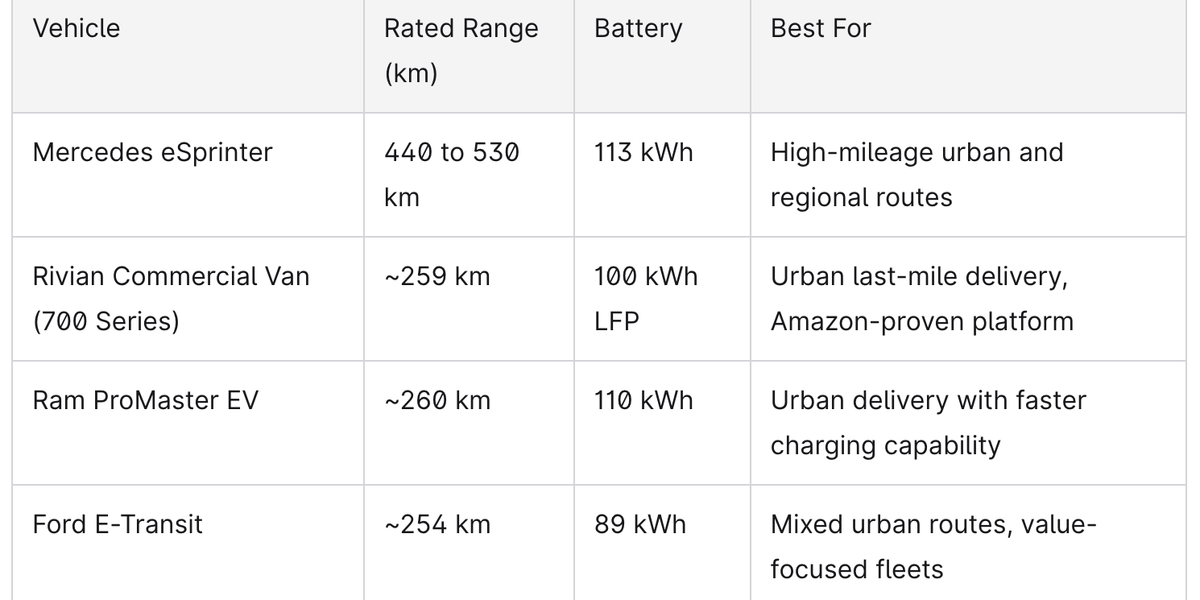
EV range comparison
The Mercedes eSprinter leads the segment on maximum range, and its heat pump system makes it particularly well suited to Canadian winters. At 113 kWh, it carries significantly more battery capacity than its competitors, which translates directly into longer trips without a mid-day charge stop.
The Rivian Commercial Van became available to Canadian fleets in 2025 after years as an Amazon-exclusive platform. Its 100 kWh lithium iron phosphate battery is built for daily charge cycle durability, and a larger-battery AWD variant is in development that will add roughly 30% more range and improve traction in snow and ice. The Ram ProMaster EV stands out for faster charging, drivers can add 107 km of range in 15 minutes on a DC fast charger, which makes it practical for multi-shift operations or routes that occasionally exceed the overnight charge window.
Note that GM discontinued BrightDrop van production in October 2025, citing lower-than-expected demand. Existing units remain in service with fleets like FedEx and DHL Canada, but no new production is available. Fleet managers shopping for new cargo vans should focus on the four active models above.
7Gen has deployed the Ford E-Transit and other commercial vans with clients including FedEx, DHL, and GoBolt, matching vehicle selection to route profile and depot charging setup.
4. What Affects Maximum Range in Real Fleet Conditions?
Maximum range figures tell part of the story. Understanding what reduces EV range on actual driving routes helps fleet managers plan more accurately and conserve energy more effectively. Every electric vehicle model behaves differently under load, and real-world test results consistently diverge from manufacturer ratings.
Payload and cargo weight — Heavier loads demand more power per kilometre. An EV van at full payload will use significantly more energy than the same electric vehicle running empty, particularly during stop-and-go city driving. Drivers should expect a 10 to 15% range reduction on heavy load days.
Highway driving speed — EV range drops at higher speeds due to aerodynamic drag. Driving at 110 km/h versus 90 km/h can reduce range by 15 to 20%. Drivers covering significant highway driving distance should factor this into their daily range plan — and fleet managers should build it into route assignments.
Regenerative braking — City routes with frequent stops allow drivers to recover energy through regenerative braking, partially offsetting the efficiency cost of acceleration. Heavy braking and abrupt stops reduce this benefit; smooth, anticipatory driving maximises energy recovery and extends range per charge. This is one of the most practical ways drivers can actively conserve energy and extend the effective range of their electric vehicle.
Climate control and heating — Heating in winter is the single largest variable for Canadian EV range. EVs equipped with heat pumps conserve energy significantly compared to resistive heating. Enabling pre-conditioning while still connected to the home charger or depot charger is one of the most effective ways to save money on energy and preserve driving range on cold mornings. A vehicle that pre-conditions on grid power before the driver's seat is occupied starts the day with more usable range.
Battery chemistry and age — Lithium ion batteries degrade gradually over time, with real-world range slowly declining. LFP (lithium iron phosphate) chemistry, used in models like the Rivian Commercial Van, degrades more slowly and performs better in repeated daily charge cycles, making it well suited to fleet applications where vehicles charge to full charge every night. Fleet managers leasing EVs over multi-year terms should account for this gradual change when planning charging schedules and route coverage.
Charging speed and power — Not all charging infrastructure delivers the same power level. Level 2 AC chargers typically provide 7 to 19 kW, sufficient for overnight depot charging. DC fast chargers deliver 50 to 150 kW or more, enabling faster charging for mid-shift top-ups. Understanding the power level and speed available at each charging location is essential for reliable fleet operation. Fleet operators should test charging infrastructure under real load conditions before committing to route assignments that depend on mid-day charging windows.
5. Matching Your Electric Vehicles List to Daily Distance Requirements
An electric vehicles list for your fleet should be built from route data up, not from manufacturer spec sheets down. The process is straightforward:
- Pull 90 days of GPS or telematics data for each vehicle and calculate average and peak daily driving distances by route
- Apply a winter range discount of 25 to 35% to any EV model you are evaluating, based on your region and season
- For cargo vans, apply an additional 10 to 15% discount for payload weight on loaded routes
- Identify which routes fall within the discounted range and which require mid-day charging
- Build your short list from models that cover peak daily distance with a 15 to 20% buffer — this is the working range figure for fleet planning, not the spec sheet number
- Factor in price and total cost of ownership across the lease or ownership term, not just the sticker
- Evaluate each model on range, charging speed, cold weather performance, and service support before making a final selection, simply enter your route data and compare models against each other on those criteria rather than on a particular make's marketing claims
- Check the parts and service network in your operating region before purchasing, particularly for newer or less common electric vehicle models
- Cross-reference eligible models against iMHZEV incentives on the NRCan Zero-Emission Vehicles page before finalizing procurement
This process turns a broad electric car ranges comparison into a short list matched to your actual operation. Fleet managers who skip this step and purchase based on maximum range alone often end up with more battery than their routes require, and a higher price tag to match.
A thorough EV range review for Canadian fleets shows that range is rarely the actual barrier to electrification. The barriers are planning, vehicle matching, and infrastructure. Fleet managers who start with their own route data, apply a realistic winter discount, and compare models against actual daily driving distances will find that most urban and regional commercial operations are fully viable today. Fleet operators ready to move from analysis to action can explore 7Gen's EV fleet solutions or connect with our team for a tailored quote.
Ready to Electrify Your Fleet?
Get expert guidance on transitioning to electric vehicles. Our team is ready to help.
Get a Quote