EV Charging Stations: A Guide for Canadian Fleet Managers
Alzbeta Lietava
Electrification Expert
Everything Canadian fleet managers need to know about EV charging stations: connector types, network coverage, costs, and how to plan routes with confidence.
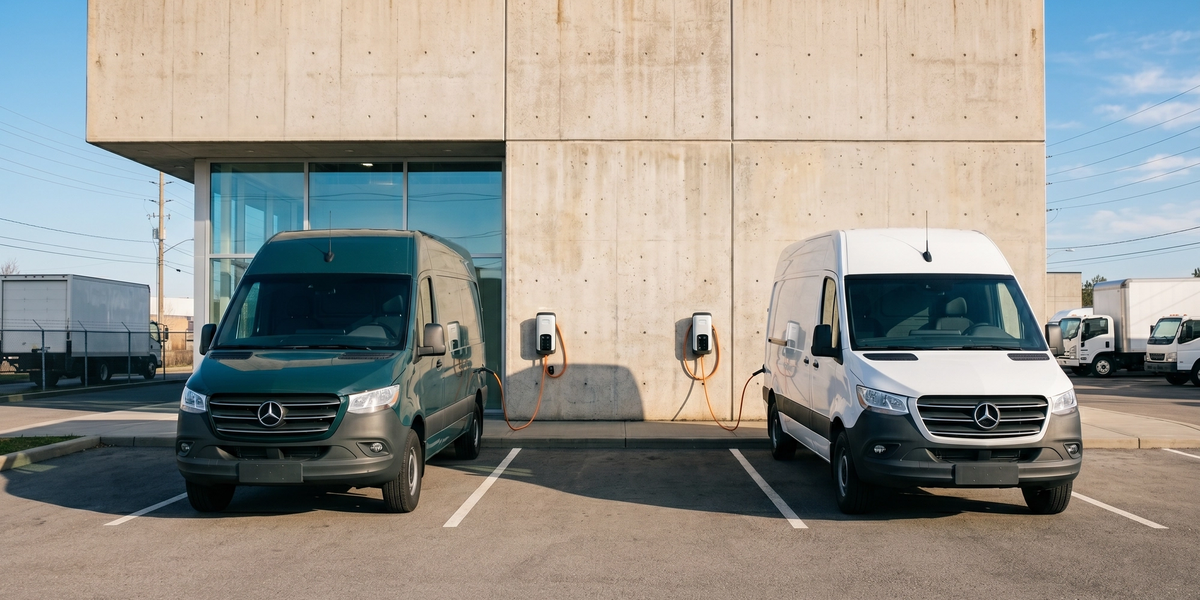
Two electric fleet vans charging at a commercial depot, concrete building, Canada.
EV charging is now part of everyday fleet operations. This guide explains how an EV charging station works, how to find charging stations, what connector types matter, and how to plan routes without range anxiety, whether you manage a delivery fleet or a mixed-use service vehicle pool.
Key Takeaways
- Charging stations increasingly rival a gas station stop for convenience, especially as fast charging and ultra-fast networks expand across Canada.
- There are tens of thousands of public charging stations in Canada and the U.S., with Level 2 for destination stops and DC charging for long trips.
- Most electric vehicles can use multiple connector types, but compatibility depends on the vehicle, plug, adapter, and network.
- Pricing varies by location, speed, and app; always check the display before you pay.
- Modern stations are built to charge safely in rain, snow, and heat, while route tools help drivers find public charging stations with live status.
EV Charging Basics: Levels and Speeds
Choosing the appropriate level of EV charging depends on driving habits, charging location, and how quickly charging is needed. There are two main types of EV chargers: Alternating Current (AC) chargers, which include Level 1 and Level 2 chargers, and Direct Current (DC) chargers, also known as Level 3 fast chargers, which provide electricity at a much faster rate.
- Level 1 charging uses a standard 120-volt household outlet and adds about 3 to 8 km of range per hour. Level 1 charging is ideal for drivers with short daily commutes or plug-in hybrid electric vehicles (PHEVs).
- Level 2 charging uses a 240-volt outlet and adds about 30 to 50 kilometres of range per hour. Level 2 public charging stations are often referred to as destination or opportunity charging, providing approximately 35 km of driving range for every hour of charge.
- Level 3 charging makes long-distance road trips viable by drastically reducing charging downtime. Level 3 charging stations can charge an electric vehicle's battery from empty to 80% in 30 to 45 minutes, making them suitable for long-distance travel.
Advertised charger power is only a maximum. A 350 kW charger will not guarantee 350 kW if the battery state, temperature, or on-board hardware cannot accept it. Many PHEVs cannot use DC fast charging, so check the owner's manual before you head out.
Connector Types and Compatibility
Before you find stations, know your connector. CCS has been the leading DC standard for many non-Tesla EVs in North America. CHAdeMO is older, mostly linked to earlier Japanese models, and is being phased down. J1772 is the common AC Level 1 and Level 2 connector for public charging in Canada and the U.S.
Tesla historically used its own connector, but many automakers and OEM programs are moving toward the North American Charging Standard, classified by SAE as J3400. Many sites still support CCS and CHAdeMO, while Tesla drivers may use adapters where allowed.
- To confirm compatibility, check the charge-port label, owner's manual, manufacturer site, or app filters by plug type.
Types of Public Charging Stations
Destination charging is common at hotels, restaurants, attractions, and city parking. These Level 2 units are useful when you will be parked for hours, and many are free or low-cost.
Workplace charging lets businesses support employees during 8 to 9 hour dwell times. Access may require an RFID card, account, app, or employee registration.
Highway fast charging hubs use DC and ultra-fast equipment along major road corridors, replacing fuel stops for long-distance drivers. Gas station forecourt charging is also growing, with 50 to 350 kW chargers near convenience stores. Urban hubs serve rideshare drivers and customers without home charging.
For Canadian fleet operators managing multiple vehicles across depots or service routes, having a clear picture of both depot-level and public charging options helps fill coverage gaps and keep vehicles moving. Solutions like those offered by 7Gen simplify this for Canadian fleets by bundling charging infrastructure, vehicle leasing, and energy management into a single monthly plan.
EV Charging in North America: Network Growth and Coverage
Public charging stations have expanded sharply since 2018. By early 2026, Canada had approximately 39,654 public charging ports, according to industry tracking and Electric Autonomy Canada. Natural Resources Canada also maintains an up-to-date station locator by province, a useful reference for fleet route planning.
There are now over 14,700 public charging station locations in Canada, and their numbers are continuously growing. Coverage is strongest in Ontario, Quebec, British Columbia, and Alberta, as well as large metro areas. Rural regions are improving, but drivers should still plan backup locations before a remote road trip.
How to Find Charging Stations and Plan Routes
The easiest way to locate public charging is with in-vehicle navigation, a phone app, or a PlugShare map. PlugShare and ChargeHub are two independent user-verified public charging maps that track the location and operating status of every public charging station across North America in real-time. The ChargeHub Canada directory also lets you browse by province, which is useful when evaluating coverage in a new service territory or planning multi-stop routes.
Both PlugShare and ChargeHub provide user feedback loops, built-in navigation, and search filters to help locate public charging stations along a route.
You can filter by connector, speed, network, price, and live availability. Many apps also let you add your exact vehicle so the map shows only compatible stations. For a city-to-city trip, a route planner may schedule 1 to 2 DC stops of 30 to 40 minutes while keeping enough range in reserve.
For fleet dispatchers, the most useful filters are connector type and minimum power output. Setting a minimum of 50 kW ensures stops are worth the time. Saving named routes in the app means drivers can navigate directly to charging stops without searching mid-shift. If your fleet has a FLO or ChargePoint network account, drivers can use a single RFID card across those networks, simplifying expense tracking and eliminating out-of-pocket payments at the charger.
Costs of Using Public Charging Stations
Charging costs can vary significantly based on the charging speed and location, with some chargers billing based on time spent charging and others based on energy consumption. Common models include per-kWh billing, per-minute billing, a session fee, idle fees, and subscriptions.
Many Level 2 public charging stations are free to use, while those that charge typically have an average cost of $1.00 per hour or $2.50 per charge. Most Level 3 charging stations charge by the minute, with an average cost of $20 per hour.
Frequent EV drivers may register for a membership plan to reduce the bill. Always compare the app price with the station display before starting a charging session.
Two factors specific to Canadian fleets are worth planning around. First, battery range drops 20 to 40 percent in cold weather, so drivers will need more charging stops in winter than the vehicle spec sheet suggests. Second, if several vehicles top up at a public fast charger simultaneously, the resulting demand spike can affect your depot electricity bill if your energy management isn't set up to absorb it. For a full breakdown of depot vs. public charging costs and how demand charges work in practice, see EV Charging Costs for Canadian Fleet Managers.
→ Use our free TCO Calculator to compare EV vs. ICE fleet costs for your operation.
Using a Public Charging Station Step by Step
- Park correctly so the cable reaches the port without stretching across a walkway.
- Identify the right connector: CCS, CHAdeMO, Tesla/NACS, or J1772.
- Start the session using an app, RFID card, contactless card, or screen.
- Monitor power, energy delivered, battery state, cost, and time remaining.
- End the session in the app or on the charger, unplug safely, return the connector, and move the vehicle promptly.
Safety, Weather, and Reliability Considerations
EV charging stations are designed for normal weather, including Canadian winters. Current flows only after the connector is latched and the vehicle confirms a safe connection. Inspect cables, avoid damaged plugs, and use the support phone number if needed.
Reliability in EV charging networks is often measured by uptime, which refers to the percentage of time that charging points are operational and signalling as available for use. The average network uptime for EV charging stations is reported to be over 98%, indicating high reliability in service availability.
User-verified public charging maps, such as PlugShare and ChargeHub, track the operating status of charging stations in real-time, enhancing reliability for EV drivers. Still, outages happen, so manage risk with a backup site.
The Future of EV Charging and Ultra-Fast Networks
The future is larger hubs, more ultra-fast charging, better amenities, and simpler standards. Newer EVs launched from 2023 to 2026 increasingly support higher DC speeds, cutting major top-ups to about 15 to 25 minutes in ideal conditions.
Expect more canopies, restrooms, retail access, renewable energy, on-site battery storage, smart charging, and vehicle-to-grid features. As NACS and CCS coexist, the charging experience should enhance convenience and reduce connector confusion.
For Canadian fleet operators navigating this shift, working with a full-service EV fleet partner makes the transition considerably smoother. 7Gen supports fleets with charging infrastructure, vehicle leasing, and ongoing energy management built specifically for Canadian operating conditions.
Ready to Electrify Your Fleet?
Get expert guidance on transitioning to electric vehicles. Our team is ready to help.
Get a Quote